20 May

YA Cafe: 5 Facts You Should Know about YA

Posted in Literature, Reading, Teen Lit, YA Cafe

Welcome Back to YA Cafe, where book lovers can gather and chat about teen literature.  I’m your barista, along with Ghenet from All About Them Words.  Today we have a few guests joining us: the Editorial Staff from Verbal Pyrotechnics, an online magazine dedicated to publishing the best teen literature on the Internet.

Each Friday we pick from a menu of topics and share our thoughts on our respective blogs.  We’ve also got plans brewing for interviews, events and even some exciting giveaways, so stay tuned!  Join the discussion by responding in the comments, on your own blogs or on twitter using the hash tag #yacafe. 

Today’s Special: The Stigma of Reading and Writing YA

I think anyone who writes or loves to read YA has experienced the Stigma.  It’s happened to me more times than I can count.  For instance, I tried lending lawyer-hubby a YA book and he said “no” because he couldn’t read a teen book on the subway… what if he ran into his boss or someone from the firm?  They would think that he *gasp* liked reading YA.  I couldn’t see what the big deal was but I decided let this one slide, after all, lawyer-hubby doesn’t make me read his boring law books.

A more painful example, though, was when I was taking a writing class with students writing in various genres.  I was the only writer in the class working on YA and when my turn for critique came up, the teacher felt the need to preface it by telling the other students to take my piece just as seriously as any other, even though it was written for teens.  I didn’t know who I wanted to smack first, the students for needing the lecture or the teacher for giving it.

It’s moments like these that leave me feeling somehow inferior for loving and writing YA.  Yet, if you look at the facts, YA is actually one of the most exciting places to be both as a reader and writer.

Fact #1: The YA market is booming… other areas of fiction, not so much.  I moderated a panel on Reading and Technology last week and of course, one of the many topics that came up was YA.  According to a publisher on the panel, one trend that’s partially responsible for the boom in YA is that adults are reading YA, more so than ever before.  These phenomenon has made it so that while the rest of publishing is struggling, YA is doing well.

Fact #2: Today’s YA is not the same YA many of us grew up with.  In fact, it’s a whole lot better.  When I was a teen, YA books at the time didn’t do much for me so I just skipped YA altogether and started reading books for adults.  If I were a teen now, though, I’d never want to stop reading YA.  There’s a lot more risk-taking going on, and books are edgier and more sophisticated.  Frankly, YA has just gotten a whole lot better in the last ten-to-fifteen years.

Fact #3: YA fans are really into their books.  As a writer, it’s so great to be writing in a category that has such dedicated fans and such a vibrant literary community.  For an “lesser-genre” we sure have a lot of fans.Want proof?  Check out this blog list of all YA book blogs.  And let’s not forget The Story Siren, who is perhaps one of the most prolific and well-known book bloggers out there, she blogs about YA.  So there.

Fact #4: You can pull some stunts in YA you’d never be allowed to do in “regular” fiction.  From an anthology about Zombies vs. Unicorns, to a fairytale about a girl married to a polar bear, to a book about the struggles of a transsexual teen, YA lets you do as much or more than adult literature.  Maybe it’s because readers are more willing to read outside their comfort zones.  Maybe it’s because the writers are more willing to write outside their comfort zones.  I’m not sure.

Or maybe it’s because genres tend to meld together in YA.  Whereas in adult literature tends to be broken up according to category, teen literature is usually shelved together.  This might be because a lot of YA often tends to cross over genres.  In adult literature, you have fantasy in one category and romance in another.  YA often combines the two.  All I know is that as a writer, I feel like I can do things in YA that I wouldn’t be able to do if I were writing strictly for adults.

Fact #5: YA is awesome!*  It’s that simple.  YA is fun, it’s interesting, it speaks to me in a way that no other category does.  Other fiction is fine and I’ll read it from time to time, but frankly, I find it a bit dull.
*OK, so this one is an opinion but you get the idea.

Have you ever experienced the stigma of reading or writing YA?  Feel free to vent about it in the comments!

Want to hear more about the Stigma of YA?  Fellow barista, Ghenet shares her thoughts on her blog: All About Them Words and our guests Verbal Pyrotechnics discuss it on their site too!  Check it out, then tell us what you think!

4 Comments »

19 May

BEA Survival Tips

Posted in Conferences, Tips

This post is co-written by me and Melissa Paris (Missy), who’s been doing the fitness series called Feel Better Write Better.  For more information about Melissa Paris, check out her blog and her Facebook page or connect with her on twitter (@Melissa_Paris).
The internet is filled with great posts giving BEA-related tips.  I recently did a BookExpo America round-up where I listed the posts I found most helpful.  Many of these posts give great advice on figuring out the logistics and getting the most out of BEA, but not all of them talk about ways to keep your mind and body healthy during that crazy week.  OK, maybe you think I’m being melodramatic, but only someone who has attended or worked at a trade show in the Javits can fully understand the utter chaos that it entails.  Here are some tips to help you keep your mind and body healthy while you’re at BEA.
BEA Survival Tips

•  Wear sneakers or shoes with good arch support.   Do not wear flats, or *gasp* flip-flops. Shoes with a little bit of a heel are easier on your feet than flats.

•  Avoid carrying heavy loads for a long periods of time.  Switch shoulders when carrying that heavy bag of books or put the bag down while standing in long lines.  When lifting that heavy bag, try not to hunch over but bend down with your knees.

•  Bring a small rolling suitcase and use the available suitcase check.  Store your books in your suitcase periodically so you don’t have to carry so much in your shoulder bag the whole time. 

•  While standing in line, don’t lock your knees.  Keeping your knees slightly bent is actually better for your posture and will make waiting in line less exhausting.

•  Take a break and go to at least one of the conference talks.  Not only will it give you a chance to sit down for a little while, but it will also let your mind rest from all the over-stimulation from the Javits Exhibit Hall.

•  Stop to refuel.  Take a break for lunch if you can.  Also, bring snacks that are easy to carry and eat on-the-go but also pack a nutritious punch.  Trail mix is a great snack, especially a mix with walnuts and dried cherries.

•  Stay hydrated.  Take a small bottle of water and refill it several times throughout the day.

•  Don’t attempt a long walk home.  The Javits Center is FAR from pretty much everything in NYC.  At the end of a long day, splurge on a taxi or take a Javits shuttle to your hotel.  If your home or hotel isn’t doesn’t have shuttle service from the Javits (check here), you can always take the shuttle to one of the hotels that does have service and take the subway or city bus from there.

•  Don’t take it personally.  A trade show at the Javits is kind of like the Bermuda Triangle: it can drive people a little crazy and make them behave like they’re not themselves.  You have to understand where everyone is coming from, though.  Exhibitors are trying to promote books and make connections with clients.  The buyers and other attendees are trying to make the most of the show and cover as much ground as possible.  Everyone’s a little frantic.  Sooner or later someone is bound to say or do something that will rub you the wrong way.  When that happens, don’t take it personally.  Chalk it up to the insanity, take a deep breath and let it go.

Do you have any trade show or BEA tips to share?

2 Comments »

18 May

DIY MFA: Working the Workshop

Posted in Community, Critique, DIY MFA

When it comes to finding a workshop for your work, you have many options available.  You can try to find critique partners (CPs) and beta readers (betas), form a critique group or even take a writing workshop.  In fact, it can be overwhelming to make sense of it all so here’s a handy dandy cheat-sheet to help you figure it out.

Critique Partners:  Critique partners (CPs) are individuals who critique your work and you critique theirs.  These are your partners in crime, writers who will accompany you on your journey.  These are the people who will be willing to read and re-read, and re-read yet again that one scene you just can’t get right.  In terms of numbers, you can have just one or two CPs, or a whole group.

Critique Group:  This is like having a whole bunch of critique partners.  Most of these groups meet in person and can stay together for years.  My own critique group meets every week, when we critique one writer’s work, rotating through the members so everyone gets a turn every few weeks.  We’re basically like a workshop, only without the teacher.

Beta Readers:  Beta readers (betas) are writers to whom you send a full version of your book.  They’re called beta readers because they essentially “beta-test” your book, the way beta-users will test out new software.  Usually betas are different people from your CPs so you can get fresh feedback on your work, though sometimes these individuals can overlap.  Betas differ from CPs in that the latter usually read your work as it’s in progress and look at more specific problems.  Betas, because they see the whole book, can give you more global comments on the book overall.

Writing Workshop:  This is a great way to meet new writer-friends and maybe even form a critique group after class is over.  My current critique group grew out of a writing class where a handful of us started the group.  The group has changed and grown over the years, but it all started with that first class.  The advantage of a writing workshop is that you have the teacher there to keep discussion moving and to answer questions on craft.

Stay tuned for more workshop and critique tips!

Now you tell me: Do you workshop your writing? What kind of workshop scenarios have worked best for you?

This post is part of DIY MFA.  For more information, check out the DIY MFA Facebook page or join the DIY MFA list to get a FREE workbook.  You can also find links to previous DIY MFA posts by going to the menu tab.

4 Comments »

17 May

No-Weights Arm Workout for Writers by Melissa Paris

Posted in Feel Better Write Better

One of Melissa Paris’ (Missy) many talents is designing workouts that you can do without any equipment.  Check out this weight-free arm workout made especially for writers.  

For more information about Melissa Paris, check out her blog and her Facebook page or connect with her on twitter (@Melissa_Paris).

A weight free upper body workout for the hardworking writer!  It’s important to get up and move around throughout the day to keep your mind focused and your body healthy.  Be a better YOU and add some simple moves when taking your writing or editing breaks.  Here’s the routine: 

• 20 Mountain Climbers.   Start in push-up position, bringing one knee to your chest then back down.  Repeat with the other side.   Both sides counts as one repetition.  Go as fast as you can; you should be out of breath when doing this.

• 15 Push-Ups.  Hands should be shoulder width apart.  If you cannot hold your body up on all fours, lower the intensity by placing your knees on the floor.

Repeat 3 times

• 10 Tricep Dips.   Use a chair: place your hands on the seat with your knees bent in front of you.  Bend your arms and dip your body down below the chair seat, then back up.  You should feel the burn in the back of your arms.

• 15 Tricep Push-Ups.  Similar to the previous push-ups but with hands close together and elbows tucked in.

Repeat 3 times

• 30 Boxing Punches.  Once with each arm is one repetition.  Do this exercise without putting your arms down to rest.

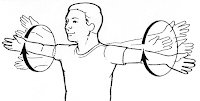
• 15 arm circles.  Forward and backward without rest.

Repeat 3 times

Wow!  These exercises look fantastic.  I plan to use them during my writing breaks to help me get active and clear my head.  Also, stay tuned for a bonus post this Thursday featuring Missy’s tips for BookExpo America.  She has some excellent tips and ways to take care of yourself and make the most of the event!

One comment »

Iggi & Gabi - All rights reserved © 2010-2011

I am a HowJoyful Design by Joy Kelley