14 Feb

My Funny Valentine: A Contest!

Posted in Kid Lit, Literature, Reading, Teen Lit

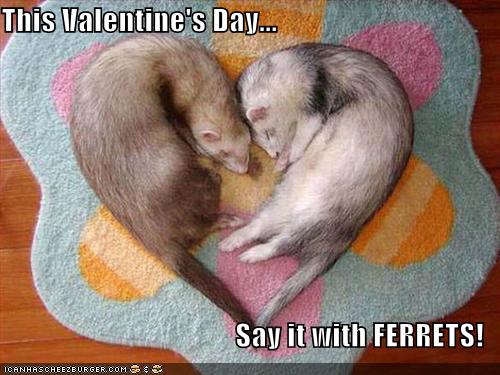
I’m one of those people who utterly detests Valentine’s day.  Don’t get me wrong, I’ve had a wonderful valentine in my life for going on ten years now, so it’s not out of bitterness that I dislike this holiday so much.  Mostly it’s because of logistics; this grotesque little holiday falls two days before my birthday.  Every year.  I also have serious issues with a holiday that encourages numerous affronts to the English language in the form of cheesy song lyrics, sappy monologues and bad poetry.

Someone needs to do something to improve the overall literary quality of Valentine’s day and I’ve come to the conclusion that the best way to accomplish this is by having a CONTEST!!!

What you need to do:  Write a valentine from one literary character to another and post it in the comments.  Easy right?  Here are a few more details:

  • Contest is Open Until: Precisely 11:59pm EST on Feb. 16 at which time I will close comments on this post.
  • Finalists:  Will be selected by moi, and will be announced on Saturday, Feb 19.  Once I announce the finalists, I’ll set up a poll so everyone can vote for the Grand Poobah of Valentine Literary Awesome.  I will post to let you know when the poll opens.
  • Prize:  $15 Amazon.com Gift Card to the Grand Prize Winner!
    Get extra bonus points and kudos in the first round if you: 
    • Use characters from children’s literature or teen literature.
    • Pair two unlikely valentines in such a way that it goes from bizarre to deliciously ridiculous!
    • Make me laugh so hard I snort milk out of my nose.
    • Make me sob so much I think my heart might break.
    • (But really, I like laughing better than sobbing.  Just FYI.)

    Ready… Set… Write!

    10 Comments »

    30 Jan

    Writing: We Are All in this Together

    Posted in Community, Conferences, Reading, Writing

    Benjamin LeRoy, of Tyrus Books, gave the closing keynote for the Writer’s Digest Conference.  While most of the sessions at this conference focused on craft or the business of writing, this keynote was pure inspiration.  Here are some clips from the speech that struck a chord for me. 
     

    “Books allow us to see the world through someone else’s perspective.”

    This is one of my favorite things about writing, or reading for that matter.  Books let us “try on” different lives and experience things we would never be able to do otherwise.  As I’ve mentioned before, story-telling is a uniquely human behavior and something that we all have in common, regardless of racial or cultural differences.  Thus, not only do books allow us to adopt different perspectives, but the very act of telling stories unites us. 

    “When you take up the pen, you are documenting who we are as people.”

    There is something about writing things down that everything seem more real.  As a teenager, whenever something happened at school, I had to write it in my journal, otherwise it was like it didn’t matter.  And if it didn’t matter, then it didn’t feel completely real to me.  In some ways, I still believe that.  As I’ve grown and studied literature, I’ve learned that even written words that are not factually true can ring true on an emotional level.  In many ways, fiction can feel more real that fact. 

    “We are all in this together.”

    As writers, it’s so easy to get caught up in things like “platform” or “getting published” but the truth is, writers and publishing professionals are on the same team.  As best I can tell, agents and editors are in this game because they love to read great writing and they believe books are important.  Writers get to supply the material.  As LeRoy explained toward the end of his talk, writers should create the best stories they can–stories that engage them–rather than trying to chase trends.

    This sounded great in theory and I wanted to believe it–really, I did.   Still, doubt nagged at me so during the Q&A, I asked the following question: 

    “Considering how the market is saturated with books about sparkly vampires, and considering how most human beings have the attention span of… say… a small rodent, how do we find readers for our engaging–though perhaps not quite so flashy–books?”

    To which, LeRoy smiled and replied: “I don’t know.”

    And this was when it all clicked for me.  Throughout the weekend, we’d heard about all the different ways that the publishing industry was changing.  eBooks.  Social media.  Blogs.  POD.  The problem is, it’s not the writing or the publishing that’s actually changing, it’s the reading.  Writers and publishers are just trying to keep up.  Sooner or later, everyone who loves books (writers, agents, editors, publishers, and anybody else) is going to have to figure out how to deal with changes in the reading industry.

    This is why it’s important to remember that we’re all in this together.  We may not be able to turn back the clock or un-invent the eReader, but we can find new ways to connect with our readers and with each other.  And that’s a start.

    2 Comments »

    24 Jan

    How Reading Can Change the World

    Posted in Conferences, Inspiration, Reading, Writing

    OK, we’ve already established that reading is awesome, but imagine my surprise when I went to the Writer’s Digest Conference and the most inspiring talk of all was not actually about writing.  It was about reading.

    Richard Nash, who gave the lunch keynote speech on Saturday, gave a fascinating talk about how writers have to be readers, how reading and writing are the opposite sides of the same interaction.  All I have to say is: OMG did he read my mind?  This is exactly the sort of stuff I’ve been obsessing over for the last few weeks.  In fact, after hearing Richard Nash speak, I am completely convinced that reading can, in fact, change the world.

    A few weeks ago, I posed the following statements for discussion.

    Writing is the ultimate form of manipulation.
    Reading is the supreme act of defiance.

    Some of you got the writing part of the equation right away.  When we write, we can control the words and how we express them to guide the reader in whatever direction we choose.  Writing–if you really think about it–is no more than a few inky scribbles on a page.  Lines and dots.  But if we’re strategic in how we use those lines and dots, we can actually put ideas into our reader’s head.  We can direct and manipulate what our reader imagines and how our reader responds.  Richard Nash had a great analogy for this concept in his keynote: “Our words are hours that we can take up inside someone’s head.”
    I don’t know about you, but I think that’s a powerful thing (and not a privilege to be taken lightly).
    But what about the reading part?  How can reading be an act of defiance?  I addressed this when I talked about types of readers last week.  Some people might read to get the information or to figure what the author’s trying to say, and that’s fine.  But the moment you realize that everything the writer’s doing with his words is essentially an act of manipulation–a way of taking up real estate inside your brain–then you can start reading like a revolutionary.  All it takes is awareness, knowing that the writer’s doing some slight of hand tricks and is trying to direct your mind this way or that.  Once you’re aware of this, you can step back and decide if you actually want to be directed.  And once you do that, you’ve become a rebel.  You’re fighting the machine.  You’re Reading.
    And how, exactly, can Reading change the world?  That’s easy.  One of the biggest problems I see with the world is that everyone out there is trying to be a writer.  Everyone’s got an agenda; they’re trying to use their words and take up mental real estate and get people to listen to what they have to say.  The problem is, very few people out there put effort into Reading-with-a-capital-R.
    I totally get why that happens, though.  Reading like that can be exhausting, sort of like watching a magic show and constantly trying to figure out how the magician pulled off the last trick. Our world is so saturated with information that it would be impossible to read like a revolutionary all the time.  We’d all lose our minds.  The trouble is, a lot of people have stopped Reading all together.  They just accept the information they see at face value and move on to the next thing.  I call this voluntary illiteracy.
    In the end, Nash’s speech came down to one important point: “Writing and reading are behaviors.  Most people do both.”  I agree completely and would add only one thing:  To change the world, we need to do both but do them responsibly.
    I thank you all for the privilege of letting me take up a small slice of your mental real estate.  Now go out there and do something amazing with your words.

    8 Comments »

    17 Jan

    Reading as an Act of Defiance

    Posted in DIY MFA, Literature, Reading

    There’s a lot of research out there on reading and how people learn to read.  Scientists use fancy terms like “sub-lexical” and “phonemic awareness” to talk about how readers give meaning to and make sense of the little black squiggles on a page.  Essentially the research boils down to this:

    Readers start out “learning to read.”
    Eventually they shift gears into “reading to learn.”

    Scientists use their big scientific words to explain the whole “learning to read” part, but what happens when readers get to the “reading to learn” stage?  Is that all there is?  Is that as good as it gets?

    I don’t think so.

    The way I see it, there are lots of different ways you can “read to learn” and it all depends on what you want to get out of the thing you’re reading.  Here’s my take on the stages of reading that happen once you’re “reading to learn.”

    The Collector:  This reader collects clues and information from the text.  She reads with a pen in one hand and a highlighter in the other.  She underlines a lot.  She makes careful notes in the margin and copious outlines.  For her, language is a means to an end; it is simply a way for a book to convey valuable information.  Boring textbooks tend to bring out the Collector-Reader in many of us, mostly because underlining helps keep us awake.

    The Interpreter:  This reader is constantly asking “what does it mean?”  He wants to know exactly what the author was trying to say with each phrase, each sentence.  This quest becomes all the more urgent if the author is no longer alive and therefore cannot be asked directly.  The interpreter believes in the infallibility of literature: that if Shakespeare put a comma in that precise spot he must have done it on purpose and therefore it has to mean something.  Just as Freud believed there are no accidents in life and all actions stem from a deeper meaning, the Interpreter-Reader is certain that there are no accidents in literature and if the author wrote it that way, then there has to be a reason.

    The Revolutionary:  This reader doesn’t worry about what it all means, because to her it doesn’t matter.  Meaning is relative.  Instead, when she reads something, she wonders “how did the author do that?”  What’s the author’s agenda and what slight-of-hand tricks is he using to pull it off?  Writers are almost always in this category because they know that when authors write something, they’re just trying to get a reaction or response from the reader.  Writers know this because they do it all the time themselves.

    The Revolutionary realizes that by putting words on a page, the author is trying to shape the reader’s interpretation of those words.  Whenever an author chooses one word over another and puts that word down on the page, he is making a decision that will shape or manipulate the reader’s response.  The moment a reader recognizes that this is happening, he or she can decide whether or not they will allow themselves to be manipulated.  It’s just like realizing that televised news broadcasts are not objective, but have specific agendas; once you recognize that, you can see past it and look for the actual information.

    More importantly, though, writers know that when look under the hood to figure out how a piece of writing works, you’re not too far from learning to build an engine from scratch.  After all, the moment you ask: “how did the author do that?” you’re just a half-breath away from asking: “how can I do it?”  And that’s what writing’s all about.

    Comments Off on Reading as an Act of Defiance

    Iggi & Gabi - All rights reserved © 2010-2011

    I am a HowJoyful Design by Joy Kelley