14 Sep

Author Readings and Literary Events

Posted in Community, DIY MFA

One great way to connect with the literary community is through author readings and other literary events.

If you live in a big city or a college town, finding author readings and literary events is not difficult.  Any school with a creative writing program or English department will most likely host at least a few literary events every semester.  For instance, The New School in NYC, where I recently received my MFA, has a great reading series and I am sure most schools with MFA programs have similar opportunities.  These days there are colleges with MFA programs spread across the world (and if you factor in regular English departments, that’s an even greater number of options).  So check out your local college or university for more info.  Local libraries and independent bookstores are also a great resource for finding readings or author talks.

I can’t speak much about literary events outside of NYC since this is the area I know best, but for those New Yorkers out there, let me share a few events/resources that I have found to be useful.

  • One best-kept-secret that I’ll share with fellow New York writers are the Gotham Writers’ Workshop free workshops in NYC.  You can find a listing of these free events here.  These aren’t exactly “readings” but more like 1hr lessons on craft, but they’re fun and they’re free!
  •  For those who love YA literature, check out the Teen Author Readings and the Teen Author Festival.  It features great writers of teen literature and is also fun and free!
  • Every fall, the Brooklyn Book Festival includes tons of great author readings.
  • Another great resource are literary magazines.  *Warning, shameless plug here*  Some of you have heard me mention Verbal Pyrotechnics in the past (BTW, we’re open for submissions).  This is a literary e-zine I’m involved with that is dedicated to teen literature, and it hosts readings in NYC.  If there’s a literary magazine based near you, check and see if they host readings as well.  This could be a great way to connect with local authors. 

But what if you don’t have a university or college nearby?  Where do you go to hear writers speak and read their work?

  • One resource that I really love is Poets.org where you can find poems and bios of several poets as well as some audio recordings of the poets reading their work.
  • Podcasts and webinars are other ways that you can hear writer’s speak (like the SheWrites radio link I shared yesterday).
  • And let’s not forget This American Life, which isn’t exactly an author reading, but often features authors and columnists and always tells great stories.

Now you might be wondering how often one “should” go to readings.  At the MFA program I attended, we were required to go to a minimum of 8 readings per semester.  For DIY MFA, it all depends on how much time you have and how much time you can dedicate to the community aspect of the program.  One reading per month would be ideal, but if you can’t swing that, do what you can.  The important thing is that you’re reaching out and meeting authors and literary folk face-to-face.  Listening to authors speak and read their work can be inspiring and motivating.

Today’s Task: Let your fingers do the walking and look up a reading or literary event you would like to attend.  Mark it in your calendar and plan to go.  Now tell me, because I’m dying to know, what event did you choose and why?

    10 Comments »

    13 Sep

    Announcement: "Commencement" Week!

    Posted in DIY MFA

    Crazy to think that September is almost halfway over.  I’m already cooking up what we’re going to do to celebrate the end (or actually the beginning) of DIY MFA and I wanted to share a few details with you.

    We’ll be having a big week-long celebration that will include keynote guest posts by some really great writers/bloggers.

    We’ll also be having a student speaker blogfest.  Our student speaker, Sheri from Writers’ Ally, will share her thoughts on the DIY MFA experience.  We’re doing the “student speech” as a blogfest so everyone can get involved and share their experiences on their own blogs and be linked through iggi U.

    On Thursday, Oct. 7, we’ll have the last Commencement Week post, where I’ll announce the winner of our DIY MFA contest and then…

    …a weekend-long Blog Party!

    3 Comments »

    13 Sep

    Learning from the Masters

    Posted in DIY MFA, Literature, Reading

    Perhaps one of the best ways to learn to write is by reading.  Thing is, to really get the most out of your reading, you have to be strategic about it.  Sure you can read for fun, but to learn the most from your reading you need to approach it thinking “how did the author do that?”

    For this reason, if you want to learn from the masters, I suggest the short form: short stories, essays and poems.  Unlike novels or other long works, the short form allows you to read and take in the entire piece in one sitting, which in turn lets you analyze how the piece is working both on the macro and micro levels.  When we read longer works, it’s hard step back and see how the work functions as a whole.  With short stories, essays and poems, we can zoom in and out, inspecting the piece at hand both in its entirety and at the paragraph or sentence level.

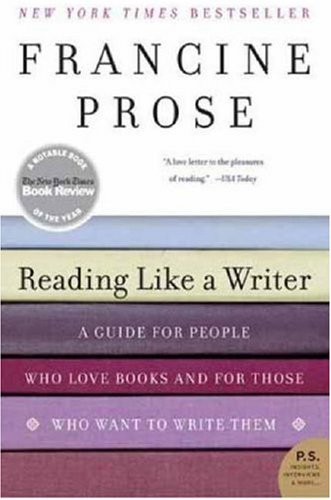
    In order to read with purpose, we first have to re-teach ourselves to read.  We cannot be lazy.  We must read as writers.  In this regard, Reading Like a Writer by Francine Prose is a valuable addition to any writer’s library.  To read a excerpt, click here.  This book guides us and teaches us to read literature with an eye toward understanding how the writing really works.  It would be impossible for me to recap here everything that Prose talks about in that book and do it justice.  Instead, I thought I’d let you hear it from Francine Prose herself.  (An interview with Francine Prose is the second listing on the widget below.)

    Listen to internet radio with She Writes on Blog Talk Radio

    It might also be worthwhile to invest in a small collection of short form works in your genre.  Below I list a few resources and books that I have found useful.  I have researched many anthologies (especially for short stories) and have yet to find the perfect one.  The resources listed below aren’t perfect, but they’re solid and a good place to start.

    Poetry

    • Poetry 180
    • Good Poems, edited by Garrison Keillor
      (This lovely collection covers a broad spectrum of poems and styles.)
    • Poets.org

    Fiction

    • The Art of the Short Story, edited by Gioia & Gwynn
      (The best short story anthology I have found to date.  It contains most of the greats and is the textbook I’ll be using in the class I’m teaching this fall.)
    • Best American Short Stories, edited by various authors
      (An annual anthology of the best new short stories published that year.)
    • Project Gutenberg
      (An online database of free books!  You can even put them on your kindle or e-reader.  You won’t find contemporary stuff here, but you will find the classics.)

    Essays

    • The Art of the Personal Essay, edited by Philip Lopate
      (A solid anthology of personal essays, from the forerunners to the twentieth century.)
    • The Best American Essays of the Century, edited by Joyce Carol Oates
      (Great compilation of American narrative non-fiction.)
    • The Best American Essays, edited by various authors
      (This yearly publication is a great sampling of the best new essays of each year.)

    Today’s Task: Choose one short story or poem and read it closely, like a writer.  Focus on what the author is doing in the story and how the author manages to pull it off.  Then, if you like, share your experience in the comments.

      8 Comments »

      12 Sep

      Mind Mapping

      Posted in Brain Boot Camp, DIY MFA

      This is a technique I learned when I was taking a creativity seminar in grad school.  Mind mapping is great for visual thinkers who need to “see” the big picture of a project.  It’s also really good to use in a brainstorming session because it forces you to look at your idea from different angles, literally.  Not sure what I mean, just try making a mind map.  You’ll turn the page around so many times, it’s almost impossible not to look at the idea from different perspectives.

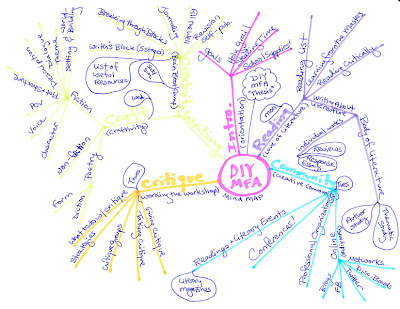
      There are as many different ways of making a mind map as there are creative people in the world, but the basics are the same.  Write the main idea in the center of the page and circle it.  Now make branches from the circle and write one topic on each of those lines.  Continue breaking off subtopics from each of those branches, creating what looks like a web across the page.  Like this:

      For example, say you wanted to use a mind map to brainstorm the world of your story, you might start with the name of your story as the center. Then your branches might be: Technology, Food, Geography, Clothing, etc.  For each of those branches then you would break down the subtopics into more detail.  This example revolved around world building but you can use mind mapping to brainstorm just about any aspect of your story.

      Some tips for making an effective mind map:

      • Use markers or colored pens to color-code.
      • Try not to judge your ideas as you draw the map.
      • Don’t be afraid to make it messy.
      • Turn the page around and look at the idea from different angles.
      • If possible, use unlined paper, to allow your ideas to flow in all directions.

      I’ll close this with a personal tidbit.  When I was in grad school for psychology, I used to take all my notes this way.  Of course, it made things difficult when a fellow student asked to borrow my notes.  They’d take one look and hand my notebook right back.  Eventually I’ve found a balance between taking notes in mind maps and using a more standard format but I still think mind maps are more fun!

      Today’s Task:  Mind map something.  Doesn’t matter what it is.  It can be your grocery list, if that’s what’s on your mind right this minute.

      In terms of discussion, I’d love to know: did the mind map help you gain insights on your topic that you might not have gained with a traditional outline?  Did it help you see your topic from a new perspective?

      11 Comments »

      Iggi & Gabi - All rights reserved © 2010-2011

      I am a HowJoyful Design by Joy Kelley