11 Sep

Morphological Forced Connetions

Posted in Brain Boot Camp, DIY MFA

Today’s subject is one of my favorite ways to come up with wacky new writing ideas.  Morphological Forced Connections uses a matrix (or chart) to generate ideas by combining different components at random.  This is a great way to generate random writing prompts when you’re stuck.
What you need:
–Paper and writing implement
–Dice

Here’s how it works:

1)  Make a list of categories relating to what you’re going to write.  Some suggestions: genre, story structure, POV, setting, form, protagonist, antagonist, prop, or anything else that comes to mind.

2)  Under each category brainstorm 6 options.  Like this:

Genre                Plot/Story Premise              POV                    Form
Romance           Fish Out of Water                  1st                       poem
Fantasy             Underdog                               2nd                      essay
SciFi                  Pygmalion                              3rd                       story
Thriller              Quest                                      Omniscient          flash fiction
Chick Lit           Star-Crossed Lovers            Peripheral            novella in verse
Picture Book     Revenge                                 Objective             email/twitter

3)  For each category roll the dice and circle or highlight the choice from each list accordingly.  The prompt for the example above is: Fantasy story about star-crossed lovers, told in 1st person through the email/twitter format.

4)  Now write.

Note: Sometimes it seems like the combination you got isn’t actually going to work.  “What do you mean I’m supposed to write a thriller quest story as an omniscient poem?”  The idea here isn’t to come up with the premise for the next great American novel.  Rather, the goal is to shake up your thinking and make you see connections you ordinarily wouldn’t see.

Today’s Task:  Come up with your own morphological forced connection prompt.  If you like, share your prompt in the comments or borrow a prompt from a fellow DIY MFAer.

8 Comments »

10 Sep

DIY MFA: Week 1 In Review

Posted in DIY MFA, Week in Review

It’s been a great first week here at iggi U.  I hope you all have enjoyed it as much as I have.

If you’re just joining us, check out the iggi U page.  It has lists of past posts as well as a link to our registration post so you can join the fun and be included in our contest!

So, how did this week go for everyone? For me it was still a bit on the crazy side but I made a good bit of progress on my WIP so the first round of iggi-tinis is on me!

Recap of this Week in DIY MFA:

Saturday: Five Stages of Writer’s Block
This post discusses five stages of writer’s block: Denial, Anger, Bargaining, Depression and Acceptance.  The idea here is that for writers to break through writer’s block, they must first identify what stage of writer’s block they are experiencing.

Sunday: Who You Gonna Call?
Creative blockbusting is all about identifying the different blocks and taking steps to counteract them.  Here we discuss risk-taking, chaos, idea incubation and flexible thinking.

Monday: Building a Reading List
The first step to approaching literature in a pragmatic and scholarly manner is to put together a reading list.  It’s important to include books from various different categories: books similar to your WIP, books that inform your WIP, contemporary books in your genre and general must-read “classics.”

Tuesday:
Writers on the Interwebs
In this post, I tell the story of how I got involved with online writing communities and share links to some of the sites and blogs that have helped me along the way.  Oh, and there’s a group project too so chime in!

Wednesday:
A Question of Character
This first post on craft focuses on character and describes two tools I’ve developed to helping me keep a handle on all the information I collect about my characters.

Thursday:
Critique Groups 101
6 important tips for participating in a critique group.  Also, a link to a great blog post that discusses how to run an effective writing group.

Final Note:  This past Monday’s post on reading lists got some great comments and I was so thrilled to see you all really thinking about your DIY MFA plans.  For real, when I first cooked up this idea, I never thought anyone would take it seriously!  You guys made me so happy.  iggi’s doing a happy dance.

DIY MFA is all about you building your own writing plan, so it’s great that you guys are really invested in implementing this project.  At the same time, though, keep in mind that not all the DIY MFA posts will be relevant or useful to every writer.  The whole point of DIY MFA is that the onus is on you to decide which techniques to implement and how closely to follow them.  While I really do believe that the 4 threads of DIY MFA are each essential, how you choose to put each thread into action depends on what your individual goals are.  My job is to present options and help spark ideas.  What you do with these options and ideas is up to you.

That’s all for this week!  But before I go I’m dying to know, how did this week go for you?

9 Comments »

09 Sep

Critique Groups 101

Posted in Critique, DIY MFA

In June of 2007, I started a critique group with some writers I met in a fiction class.  This group started out pretty loosey-goosey, but over the years, we’ve developed a structure, built a rapport and formed lasting friendships.  Eventually we coined a name for our group: Quill&Coffee.

Whether you’re looking for (or starting) a critique group or are in a group already, here are some tips I’ve learned in my three years with Quill&Coffee.

Joining (or starting) a Critique Group 

1)  Follow the rules.  At first.  If you’re joining an already established group, it’s a good idea to follow the group’s rules and standards.  Avoid submitting your work at the last minute and make attendance at the meetings a priority.  At the same time, don’t be afraid to voice your thoughts and suggestions about how the group is managed.  Just make sure you build a rapport with your fellow writers before you start trying to change how they run things.

If you’re starting your own group, make guidelines and try to stick to them.  Things to consider are: How often will you meet?  How often can each writer submit?  Do you need a schedule?  What does everyone expect in terms of critique (full letters? margin notes? brainstorming?)  And how do you plan to run the actual critique session?  Of course, you can always change the rules as you go, but it’s important to start with guidelines in place. 

2)  Find like-minded writers.  This is true both when joining a group or starting one.  Perhaps the most important thing in a critique group is that the writers be more or less in the same phase of writing and publication.  If one writer has several books published while the rest of the group is just dabbling in short stories, there develops an imbalance in the group dynamic and it becomes difficult for the to have a useful dialogue.  When shopping around for a critique group, look for other writers who are in the same boat as you (or, if you’re ambitious, writers who are one or two steps ahead) but try to avoid groups where the writers are on a completely different plane. 

3)  Look outside your genre.  Again, both when joining a group or when starting one, it’s good to consider writers of genres different from your own.  One of the most valuable things about Quill&Coffee is that each member writes in a different genre.  While we are all more or less in the same place in our writerly development, we also each bring something different to the table with our writing and our critiques.  Of course, some writers can also find very strong and valuable critique groups within their genre.  If a mixed-genre group is not for you, that’s OK.  But even in a group with a specific genre focus, it’s a definite plus if the members have different perspectives on the genre and different styles of writing and critique. 

Once You’re in a Group

4)  R-E-S-P-E-C-T.  OK, this one’s a no-brainer and it applies whether you’re looking for a group or already in one.  Still, I think it bears repeating.  Writers in a critique group should treat each other with respect and have each other’s best-interest at heart.  If you’re shopping for a group and the writers don’t respect each other… RUN, don’t walk.  If you’re in a group and a writer is being disrespectful, then it’s time to have a serious talk with the offending party.  In the land of critique groups, respect is gold. 

5)  Play to each other’s strengths.  After working with my writer’s group for almost four years, I’ve learned who to go to when I have specific questions or concerns about my work.  Each member of the group is good at something different and by recognizing and embracing these differences, I’ve learned to maximize what I get out of my critiques.

One technique I use when I’m submitting a long chunk of writing is I ask each member of the group to focus on a different aspect of craft.  For instance, I’ll ask one person to focus on character, another on plot, etc.  Of course, if I’m submitting something short, I won’t limit people’s critiques in this way, but for long submissions, I’ve found that it helps to give people a topic to focus on while reading.  Also, because it’s a long submission, this technique helps make sure that the areas I’m worried about get covered in our discussion. 

6)  If things aren’t going right, talk it out.  Open lines of communication are essential with a critique group.  After a while, this will come naturally because the longer the group stays together, the more you will see each other as friends as well as colleagues.  My critique group recently went through some growing pains and for a while it looked like things would fall apart, but we were able to talk things out openly and work out the situation. 

For more information on running a critique group, read this very helpful post: Writing Group at Waldorf to your Astoria.

In the end, my wish for all of you is that you already have–or are able to find–a group that fits you as well as Quill&Coffee has fit me.

Today’s Questions-of-the-Day are: Are you in a critique group?  What’s the most important thing you’ve learned by being in a group?  What advice would you give someone who’s looking to join a group?

If you’re looking for a critique group or critique partners, tell us a little about your writing and what you’re looking for.  Who knows, maybe someone else in DIY MFA is looking for the same thing and you can connect.

18 Comments »

08 Sep

A Question of Character

Posted in Character, Craft, DIY MFA, Writing Exercises

Today is our first day of the Craft component of DIY MFA and I’ll begin with a caveat.  Craft is a HUGE topic and there’s no way I’d be able to cover every detail in just four posts.  Think of these Craftivity posts each as an “amuse bouche” to whet your palette, teasers to spark further study.

Today’s topic is character.  One of the things I often have trouble with when developing characters is keeping track of all of their traits and details.  Here are two tricks I’ve come up with to help keep tabs on my characters.

Character Compass

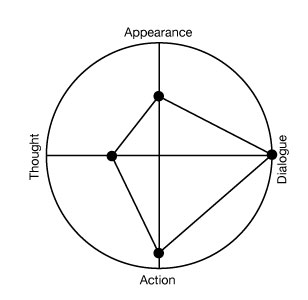
I’m sure most of you have heard the adage: Show, Don’t Tell.  Well according to Writing Fiction (Gotham Writers’ Workshop), there’s not one, not two, but four ways you can show your character’s traits.  These are: Thought, Appearance, Dialogue, Action (or as I like to call it, TADA!).  I don’t know about you, but I have enough trouble juggling one aspect of my character at a time, much less four of them simultaneously.  This is why I devised a tool called the Character Compass.

Here’s how it works.  You draw a circle with two perpendicular axes (see example above).  Label each axis with the TADA techniques.  Now draw a dot on that line to indicate how much of each you used for that character in a given scene (the closer the dot is to the circle’s edge, the more of that technique you used.)  Connect the dots and you get a visual representation of how you showed that character.

Now I can guess what you’ll say next.  Do you really have to use the same amount of all four TADA techniques?  No.  The point of the Character Compass is to highlight what your tendencies are.  For example, using the Character Compass on a WIP, I learned that I rely a lot on dialogue and actions to show characters’ traits but I rarely use appearance and I’m terrified of using thought.  This exercise was a wake-up call for me because it showed me areas of my characters that I had been neglecting.  I realized that in order to be a versatile writer it’s important that I be comfortable in using all of the TADA techniques, not just one or two.

Acrostic “At-A-Glance” Bio

Another trick I picked up is what I call the Acrostic “At-A-Glance” Bio for my characters.  I’m sure many of you can relate when I tell you that I write these long, extensive bios for my characters.  Trouble is, I forget half of the information when I actually sit down to write.  I got frustrated paging through long documents to look up details about my characters so I devised this method of creating “At-A-Glance” Bios.  These character bios are so small, I can write them each on one index card and tuck them in my notebook.  Here’s how it works.  (This technique was inspired by the poetry of one of my favorite authors, Lewis Carroll.)

Step 1: Write the character’s name vertically on the page so that each letter gets one line.
Step 2: For each letter of the character’s name write a trait or important detail about the character.

Example: Cheshire Cat from Alice’s Adventures in Wonderland

Cat
His grin stays behind
Eccentric
Says “we’re all mad here…”
Hides out in Wonderland
Invisible at times
Reappears gradually, sometimes not completely
Exceedingly mad

Croquet with the Queen
Appears and disappears
Talks in riddles

These acrostic bios are tricky but they force you to think of your character in terms of specific, concrete details.  In the end, I haven’t abandoned regular character bios completely, I just use these acrostic bios as a way to keep the most essential traits of my characters on the tip of my mind.

Today’s Task: try your hand at one of today’s techniques.  Or, if you prefer, share another tip or trick you’ve used that relates to developing characters.

20 Comments »

Iggi & Gabi - All rights reserved © 2010-2011

I am a HowJoyful Design by Joy Kelley