22 Sep

Technical Tips for Writing Dialogue

Posted in Craft, DIY MFA

Hi everyone, today we’re going interactive again.  Below is a piece of dialogue between iggi and me and your job is to find all the things that are wrong with the dialogue and make it NOT work.  When you think you have your answer, scroll down and read about some technical tips on how to make dialogue soar.

Here’s the dialogue sample.

“iggi, I’ve been meaning to talk to you.” Gabi said.
“What is it, Gabi?” iggi replied questioningly.
“Well, iggi, you know I’ve been working on this DIY MFA thing for some time, and I thought we should do a post about dialogue.” Gabi explained patiently.
“Gee, Gabi, that’s a great idea!!!!” iggi exclaimed eloquenty.
“So, what sorts of things do you think we should include in our post?”
“Hmmm…” iggi pondered.  “Maybe we could do an example of what NOT to do in dialogue, and let our readers try to guess.”
“Hey, that’s good!  I like it!” Gabi cried out.
“Let’s start writing, right away!”
And iggi and Gabi ran off to the computer to write the post.


All right everybody, now it’s your turn.  There are at least 7 different major types of dialogue problems in the above passage, though each problem may occur several times.  Once you think you’ve guessed all seven, scroll down to read the explanations.


1)  Name-calling:  Very rarely do people call each other by name when they’re speaking, but you’ll see it happen in written dialogue, especially if written by beginning writers.  The reason of course, is that using names in dialogue makes it very easy for the reader to figure out who’s saying what, especially if you’re writing a scene with more than two people speaking.  But this is not realistic, nor does it make for good dialogue, so cut out the name-calling.

2)  Exposition:  We’ve all seen those movies where the good guy faces off with the villain and the villain starts to monologue, explaining all the ins and outs of his diabolical plan.  That kind of exposition in dialogue rarely works because, again, people don’t talk that way.  If the information has to go in the scene so the reader can follow what’s going on, take the exposition out of the dialogue and just give it to the reader as straight exposition.  Here’s a hint: if a character says “as you know…” or “remember how…” or something to that effect, that’s a good tip that exposition is coming and you need to rework it.

3)  Fussy Tags:  Sometimes writers start getting all fancy with their dialogue tags, using words like “muttered” “cajoled” or “jeered” but these verbs do nothing more than call attention to themselves.  Sure, in general, writing thrives on strong verbs, but when writing dialogue tags, these fussy verbs just distract from what’s actually being said.  I prefer to keep my dialogue as mostly he said/she said with “asked” and “replied” tucked in there now and again.

4)  Ugh, Those Adverbs:  Seriously, writers need to stop adding adverbs to their dialogue tags.  Period.  Adverbs are bad enough in exposition, where they’re camouflaged by imagery and metaphor, but when they’re used in dialogue tags to express the speaker’s emotion, they stick out.  Granted, the adverbs in the above passage are a bit excessive even for an example of what not to do, but I made them especially bad to drive the point home of how awful these adverbs sound in dialogue tags.

5)  Dialogue Zits:  Words like “well” “so” “gee”  “ugh” and the like are what I call dialogue zits.  The description is exactly as it sounds.  These words blemish the complexion that is your dialogue and should be eradicated.  The only situation I think where these dialogue zits might suit a purpose is if they help establish a character’s verbal quirks in some way.  If your character really does use “like” every other word, then sprinkle it in now and again.  Remember: a little zit goes a long way.

6)  Talking Head Syndrome:  Some writers can get away with writing all dialogue, with no tags or stage directions.  These writers are the greats and they get away with it because they slip stage directions in with such subtlety that you barely realize they’re there.  The rest of us, must use stage directions in order to avoid having our characters come across as talking heads.  Stage directions are your friends.  If a character says “don’t worry about me, I’m fine” and then throws the remote control at the TV, we know right away that something is going on.  Use stage directions to create subtext and give your dialogue a context.

7)  Punk.  Choo.  Ay.  Shun.  Here it is for the record: how to punctuate standard dialogue.  Learn it, love it, live it.

“My name is Gabi,” she said.

When using a dialogue tag, a comma goes after “Gabi” but before the closed quote.  “She said” is not capitalized.  Period at the end of the tag.

“What’s your name?” she asked.

The same rule holds true when the piece of dialogue ends with a question mark.

“My name is Gabi.”  She ran her hand through her hair.

When including only a stage direction without a tag, put a period after “Gabi” and “She” is capitalized because it is the beginning of a new sentence.

For more information: visit Nathan Bransford’s recent post about writing dialogue.  I focused more on technical stuff here, but he gives some great insight into the big picture stuff, so go check it out.

Today’s Task:  Found any other problems with the above dialogue?  Seriously, there’s got to be more than just seven… Please share with everyone in the comments.

9 Comments »

21 Sep

Choosing the Right Conference

Posted in Community, Conferences, DIY MFA

‘Tis the season for conferences and other writerly events but sometimes choosing the right event can leave us flapping our feathers.

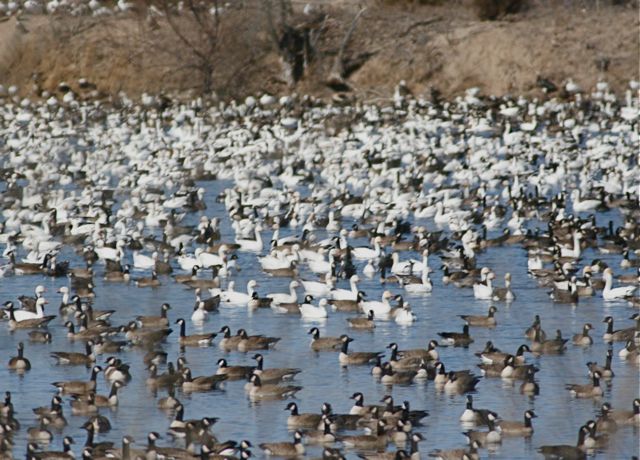
Of course, we can always take the easy route and follow the flock, but what good does that do us as writers?
 

In the end, we must choose the right kind of conference to suit our needs, so that we can commune with other birds of a feather.

And that brings me to the core of this post.  Just as there are many species of geese, there are many different types of conferences, but in my experience–having attended several–there are three basic types: Wild Goose Chase, Good for the Gander, and Mother Goose.

The Wild Goose Chase (AKA the Publishing Conference) is all about getting published.  Speakers are mostly industry professionals–agents and editors–who share insights on how to write a pitch, what should/shouldn’t go in your query and the overall publishing process.  These publishing-focused conferences are very useful for writers who know little about the actual publishing process, but it can become repetitive over time.  After all, you can only hear the “how to get published” talk so many times before you just have to go out and write the darn book.  Also, I find that going to this type of conference too early on in the writing process can discourage some writers.  Instead, I would recommend holding off on a publishing conference until you’re feeling pretty good about your draft or are ready to start the query process.  At that point, then, the more information you get about the business, the better.

The Good for the Gander (AKA Craft-focused Retreats) is great fun and is especially useful if your writing is in need of some serious shaking up.  These conferences usually include a mix of publishing talks from industry professionals and inspirational talks by published authors but the core focus is on the craft itself.  Often these types of conferences involve reading writing samples from fellow writers and discussing them in a workshop setting.

The Mother Goose (AKA Inspirational Conferences) is all about inspiring the writer within.  Sure, there will be some opportunity to hear industry leaders talk about the biz but the main focus is often on inspiring writers to keep… writing (duh).  These are the warm ‘n fuzzy conferences where you leave inspired to run home, boot up the computer and start the fingers flying across the keys.

If you’re looking into a conference, how do you know which species it is?  Look at the schedule of events.  Who are the speakers?  Is it mostly authors with a publishing panel or two thrown in for good measure?  Then it’s probably a Mother Goose.  Or are the majority of the talks all about publishing?  If yes, then you’re heading for a Wild Goose Chase.  And is there a workshop component?  If so, you’re most likely going to a conference that’s Good for the Gander.

Ultimately, there’s no one type of conference that’s better than another, but when you invest the time, money and effort to attend a conference, you’ll be best served if you go to a conference that suits your needs.  If you are at the point where you need to start informing yourself about publishing, a publishing-focused conference is for you.  If instead, you want to connect with other writers and rekindle that love of writing, an inspirational conference is probably more your vibe.  And finally, if you want to get new perspectives on your work, a workshop-retreat is your best bet. 

What type of conference do you think would suit you best at this point in your writing?

12 Comments »

20 Sep

Writing About Individual Works

Posted in DIY MFA, Literature

Up until now we’ve been talking about what and how one should read for DIY MFA.  These next two weeks we’ll be talking about responding to the literature, in particular responding on both the micro and the macro level.  This week, we’ll be discussing how to approach individual pieces of literature and ways you can respond to them in your writing.  Next week, we’ll talk about creating a meta-analysis of the literature in your field, why that’s important and what you gain by doing it.

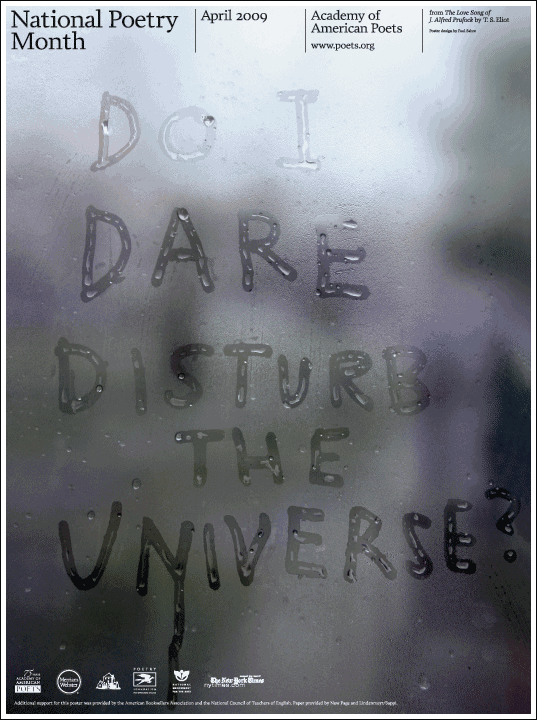
This week, I chose an image that is the National Poetry Month poster from 2009.  I selected it because of the quote, which most of you will probably recognize from the T. S. Eliot poem, but which lovers of YA literature will also remember from Robert Cormier’s novel The Chocolate War.  This was also the title and topic of one of the earliest response papers I wrote for my Teen Lit class, my first year at The New School.  It was in this class and my subsequent literature courses that I really learned to appreciate the task of responding to literature in my writing.

In my mind, there are three main ways you can respond to individual pieces of literature: Reviews, Response Essays and Technical Experiments.

Reviews
This is the most basic way you can respond to the literature in your writing.  What did you think of a book?  Why did you like it or dislike it?  Many of you may already write reviews on your blogs, so if you’re ready to raise the stakes a little.  One way to do this is to do a more in-depth analysis of the work.  Focus not so much on what the author is doing, but why and what these choices accomplish.

Response Essays
These essays are not straight reviews of a book, in fact, they might not a book at all.  Instead, what you do for a response essay is take a theme from a work of literature and run with it.  There are two loose categories for response essays: analysis and personal essay.  Some ideas for each category might include (but are not limited to):

Analysis:

  • Choose a page of the work and do an in-depth, sentence-level analysis (this works best for works that have very rich language and imagery)
  • Choose a secondary character and do an analysis of the role he/she plays.
  • Take a main theme of the work and then choose one scene and discuss how it furthers that theme.

Personal Essay:

  • Take a quote from the work that represents a strong theme and apply it to your own life in some way.
  • Choose a theme from the work and tell a story of that theme at work in your own life.

Technical Experiments
This is perhaps the most challenging approach to writing about literature.  In this case, you take a technique that the author uses in a particular work and try to apply it to your own writing.  In this type of writing, you don’t focus on the actual work itself, but simply try to figure out how the author did what he did, and how you can apply it to your own work.

OK, so I’ve written something.  Now what?
I can guess what you’re thinking: what’s the point in writing these papers if you’re not actually handing them in for school.  Not to worry, your efforts will not be for nothing.  Reviews can easily be posted on a blog and personal essays can be polished and submitted to appropriate markets.  Finally, technical experiments only serve to strengthen your W.I.P. so they are worthwhile in and of themselves.

So go ahead, disturb the literary universe a little and write a response paper.  I won’t tell.  In fact, I think I’ll do it too.

7 Comments »

19 Sep

Guest Post: Merrilee Faber Writes About Creative Revision

Posted in Brain Boot Camp, DIY MFA, Process

Today’s guest post is by Merrilee Faber who recently hosted a Creativity Workshop on her blog Not Enough Words.  In this post, she approaches the revision process from a creative standpoint.  Thank you, Merrilee!

But first, a short bio.  Merrilee Faber lives in the sand and fly infested west of Australia, where she battles giant spiders and venomous snakes every day in a desperate attempt to survive.  When not defending her family from Australia’s deadly denizens, she tries to earn a crust by telling people what to do, with moderate success.  She is a consummate liar, but gets away with it by calling it “fiction”.  You can get to grips with Merrilee at her blog Not Enough Words (http://notenoughwords.wordpress.com).

Revision would have to be the least popular part of the writing process.  You’ve slaved for weeks, months (even years!) to produce this manuscript; through the good days and the bad days and the why-didn’t-I-take-up-cat-herding-it-would-be-easier days. 

Now here you are, exhausted, drained, a rumpled, coffee-stained manuscript in your hands, facing the realization that you are not finished yet.  That there is so much more work to do.

Is it any wonder our tired muse rebels?  So we rush through revision, changing a word here, a scene there, cutting great chunks out of the story because we have to.
After all this time we want nothing more than to be complete.  So we tuck the muse away and approach revision like a dirty job that has to be done.

But revision can be, should be, as creative a process as writing the first draft.  The revision stage is an opportunity to turn your story up a notch.  And this is something you cannot do without engaging your creative side.

So how do you go about creative revision?

Distance
Let the landscape of your story become unknown.  If you are too familiar with the story, it is more difficult to write fresh.  I recommend at least a month, and that month spent thinking and writing other stories.

We tend to fall in love with prose, and don’t want to change what sounds good.  But you must be prepared to scrap everything, even those sentences you love, to improve your story.  And you can only do this as a dispassionate observer.

Question every decision
Fiddling with word choice and rearranging scenes and phrases is just cosmetic.  While it’s nice to tidy, you need to go deeper.  Get your hands dirty. 

Look at every choice you made while writing.  Was it the right choice?  What can you change to make this moment/character/scene stronger, tighter, have more impact?  Dig beneath the surface and find more meaning, more impact from the events in your story.  Keep that inspiration coming, because more often than not, the second idea is better than the first.

 Build depth and complexity
Revision is the time when you should be adding metaphor.  Placing foreshadowing for critical events.  Developing and strengthening your theme.  Retooling your characters to add subtle layers to their psychology.  Don’t be content with what you already have.  Add layer upon layer to your narrative.  Add touches of colour and voice.  Build a web of character and event and place so tight that no-one can escape the clutches of your story.


Make every word pull its weight
You are wordy.  Don’t deny it.  Embrace the fact, and then get out the hacksaw.  90% of your adjectives can go, and 99% of your adverbs.  There will be repetition everywhere.  Say it once, say it right.  Bin the rest.

This may not sound creative, but this is where you use your creativity as a fine-pointed tool.  Slice delicately.  Excise, tune, think about every phrase, every word choice you have made.  Does this word or phrase convey the tension, the impact of the moment?  How can I say it stronger?

And of course, now is the time to get rid of all the clichés.  It’s fine to use them in the first draft – they’re fast and simple and you don’t need to think about them.  But leaving clichéd phrases and ideas in the final manuscript is a crime against literature, and even worse, it’s boring.  Don’t be a bore.

Revising creatively leads to a stronger manuscript.  If you approach this important stage without your creativity engaged, you are short-changing your story. 

So next time you are facing a first draft that needs review, let go of that feeling of dread.  Approach the revision stage with joy, knowing that you are still creating.  That your inspiration is just as important now as it was when you started to write.

11 Comments »

Iggi & Gabi - All rights reserved © 2010-2011

I am a HowJoyful Design by Joy Kelley