27 Oct

The Big MFA Question

Posted in DIY MFA, MFA and Beyond, Writing

Today Kidlit.com posted an interesting article: Should You Get an MFA?

This, of course, is the central question to anyone pursuing a DIY MFA.  Should you uproot your life or perform feats of time-management acrobatics in order to go back to school?  Or should you go it alone?

I chose the former and was glad I did because the MFA program taught me several things, though not all necessarily about writing.  We learned about the literature in our field and attended several publishing talks.  Of course, it helped that the program was specific to children’s writing.  At the same time, though, I realized when I graduated that the MFA is not for everybody, which was the whole thought process that motivated DIY MFA back in September.

Now, as we near the end of October, I wanted to check in with all of you who participated in DIY MFA.  How is everything coming along for you?  Have you found some readings to attend and read some good books from your list?

Most importantly, how’s the writing coming?

4 Comments »

22 Oct

Which Comes First?

Posted in DIY MFA, Literature

Last week, I got an interesting question about writing big papers and coming up with the argument.  The question was:

“Is it more like an argument that you will prove or disprove by reading the books? I don’t know how I can make such any statement without reading the books and finding out how authors are approaching a topic…”  ~Kerryn Angell

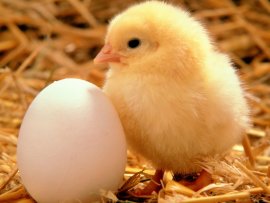
This question got me thinking about the chicken-egg dilemma that often accompanies academic papers.  The problem is this: most papers we write in high school, college and even graduate school are artificial.  The parameters of the paper force us to look at only a limited number of works and construct an argument from there, ignoring the rest of the canon.  Not only that, oftentimes professors require us to get a stamp of approval on our “thesis statement” before we’ve even read the books!

The reason professors and colleges often use this method is because of a simple, yet powerful constraint: time.  Students just don’t have the time to go on a hunting expedition to craft a scholarly paper so the teachers narrow the task down for us.  They limit the number of books we discuss in the paper, they check our thesis statements before we start, they make sure we’re headed in the right direction.  They do all of this because they want students to focus on learning to write the paper, and not waste hours of time hunting down a thesis through piles of books.

In DIY MFA things are a bit different.  We have the freedom to make mistakes, beat our head against the wall and have a few false starts.  When I wrote my literature thesis for the MFA, I didn’t tell the professor but I read at least ten books that fit the thesis.  We were only allowed to choose four, so I chose the ones that best illustrated my point and saved the rest of the books for later.  Someday I will go back to that literature thesis, rewrite it to encompass all the books I want to include.  But that is a project for a later time.

My point is, that when you’re writing or planning the “Big Paper” for DIY MFA, you have the freedom to explore the literature first.  Read a lot.  Think a lot.  Then make up your mind about what you want to say about the literature.  The goal here isn’t to write a mind-blowing paper (though that would be awesome).  Rather, the point is to build a strong relationship with reading and to see how books fit together, relate to each other.

In this aspect of DIY MFA it’s OK to be a detective.  In fact, that’s probably a good thing.  And who knows, maybe as you sleuth out your argument and look for connections between books, you might just find a few of these.

3 Comments »

19 Oct

Fitness for Writers by Missy Groeger

Posted in DIY MFA, Feel Better Write Better

Today’s post is by Missy Groeger, my good friend and fitness guru.  She’s a personal trainer at New York City’s Reebok Gym and has a background in nutrition as well as fitness.  A workout machine, Missy has participated in several fitness competitions, including Nationals.  Lately, I had been tossing around ideas on how to add a fitness component to DIY MFA and I KNEW I would have to ask Missy her advice.  Here follows Missy’s customized workout and fitness session, specially designed for writers who spend most of their time sitting at their computers.

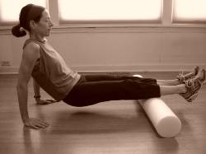
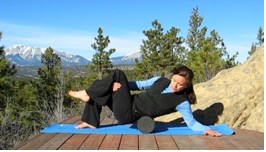
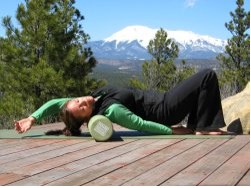
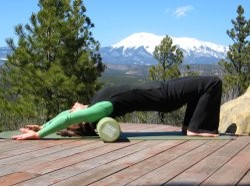
Foam Rolling:
Foam rolling helps break up adhesions from everyday wear and tear.  It is like getting a massage.  The action of foam rolling helps so you can use the muscle to its maximum extensibility and decrease chances of pulling a muscle and also reduce soreness!  (You can find foam rolls at fitness stores like Sports Authority and they come in a variety of lengths for easy storage.)

Roll over points at which you feel the most pressure and hold for 20-30 seconds.  Repeat 2-3 times.

Calves
Lower Back
Shoulder
Upper Back
 

Stretches for Major Muscle Groups:
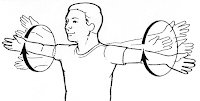
There are many benefits of stretching.  It reduces muscle tension, increases range of motion in the joints, enhances muscle coordination, and increases circulation, which raises your energy level.  The following stretches are good for your hamstrings, lower back and hips, areas crucial for writers to stretch since you spend so much time seated.

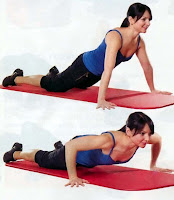
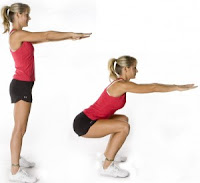
Basic Strengthening Exercises:

(Do 3 sets of 15-20 Repetitions per exercise)

Lunges
Push-ups
Squats

Superman (hold for 30-60 seconds)
Plank (hold for 30-60 seconds)
Side Lunge

Five things to keep in mind:

  1.     STRETCH
  2.     Work Large muscle groups
  3.     Sit up straight at your desk/computer
  4.     Get rest!!  Your muscles need time to repair themselves
  5.     Eat regular smaller meals

4 Comments »

18 Oct

Going it Alone

Posted in Community, Critique, DIY MFA

As a writer, at some point you’re going to find yourself alone.  Maybe it’s because a deadline has got you shut up in your house for days, weeks, months even.  Maybe it’s because you’re just not ready to share your work even with your most trusted readers.  Maybe it’s because you feel your work is fragile right now and you have to protect it from interlopers.  Whatever the reason, you and your work will become each others best company, so you’d better get along.

This is why I love this tree in the picture.  It’s a lone cypress tree just of the coast of the Pebble Beach golf course in CA.  It’s the only thing of green on that rock and yet it holds on with such tenacity.  It stands there, daring the world to get in its way: proud, tall, and alone.

Sometimes as writers we have to be the tree.  When people say “you can’t grow there, it’s a big rock” we just have to dig our roots in wherever they’ll squeeze and show those doubtful meddlers we can grow.  When people say “you’re all alone, a freak, an outsider” we just shrug, look out at the ocean and remember that while we might be alone, we’ve got the best view on the planet.

When it comes to writing, community isn’t just about knowing when to connect with people, it’s about knowing when you need to go to that room of your own and close the door.  When nurturing a small sprig of story, we can’t let everyone water the plant or it will drown.  New ideas are fragile and can get easily squashed if not protected.

Julia Cameron calls this “containment” and I agree.  I’ve made the mistake in the past of letting too many writers and non-writers into my “circle of trust” and subsequently stories have been pulled in every old which-way and got torn to pieces.  Now I have a smaller circle of trust.  One person reads my rough drafts and pushes me forward, five readers form a critique group that reads more polished work and one reader is my go-to person for career stuff and big-picture notes on my work.  The rest of the time, my best company is me, myself and I.

What about you?  Are you comfortable going it alone sometimes?

5 Comments »

Iggi & Gabi - All rights reserved © 2010-2011

I am a HowJoyful Design by Joy Kelley