20 Nov

Unique

Posted in Brain Boot Camp, Craft, Process, Writing

Here’s the ugly truth:  No writer exists in a void.  All writing is influenced by what has come before.  There is no such thing as utterly, completely unique because writing exists within a context.

In a world that’s always screaming for the Next New Thing, how do we writers reconcile that with the scary truth that there’s really no such thing as new?  Here are a few things I learned as I completed my WIP draft.

1)  Write what you love, not what the market “wants.”  I used to work in the toy industry and it always boggled my mind that we had to predict what kids would “want” not now but a year from now.  We could spend a whole year developing a product only to discover at the end of it all that the trend was over.  The same is true for writing.  If you’re working on your project because the genre or topic are a big hit now and you want to jump on the bandwagon, chances are you’ll be disappointed.  But if you’re working on this book because you love the subject and the characters, then no matter what happens, it’s win-win.

2)  Context isn’t something to be afraid of.  Think of it as a “safety net.”  In the product development world, companies love to create extensions of popular product lines.  After all, a good chunk of the development legwork has already been done in the first version, customers recognize the brand and there’s already a built-in market for it.

Think of books that came before yours as a similar “safety net” to your project.  Study the books–both the successful ones and the less so–and think about what made them work or not work.  Think about what you can do to differentiate your project from what has come before, but still keep it within the context.

3)  Find partners in crime.  One of my favorite things to do is go to conferences!  I love meeting other writers, learning about the craft and hearing new information about the business.  This January 2011 I’ll be attending the Writer’s Digest and SCBWI conferences, both in NYC.  If you’ve signed up for either of these, let me know in the comments!  I love connecting with new writer friends.

The way I see it, you never know who you’ll meet at one of these things.  It could be a new critique partner or beta reader, it could be someone you’ll collaborate with some day, it could be a future mentor or someone you might mentor yourself.  The key is to be open to possibilities.

4)  Ideas are not books.  Books are books.  In his memoir, Lessons From a Lifetime of Writing, David Morrell talks about the distinction between the idea and execution.  Every time I start getting down about how un-unique my ideas are, I reread his chapter on plot where he discusses this subject.  His main point is this: sure, an idea might be shiny and new, but an idea does not make a book unique.  What makes a book unique is how the writer implements the idea.  An example:

Take the Harry Potter series–many people marvel at J.K. Rowling’s originality. “How did she come up with such a unique idea?” they wonder.  As if all it takes to create a fantastic book (or series of books) is one extraordinary idea.  Because when you have the fun flashy idea then the book just writes itself.  Ha!

I don’t know about you, but I find this outlook to be rather belittling to the writer; it’s almost as if the writing doesn’t matter.  But as we all know, Harry Potter is about much more than just one sparkly idea.  These books are what they are because the author wrote them.  That same concept in the hands of any other writer would have turned out to be completely different.

5)  Ideas are like subways: any minute now there will be another one.  When I worked in toy development, our department had a attitude that boiled down to this: “If a competitor wants to steal our idea, let it.  We’ll have an even better one in five minutes anyway.”  The minute you think of your idea as one link in a long chain of great ideas, then that one idea doesn’t seem all that ground-breaking anymore.  If you coddle and protect your idea like it’s something precious and priceless, you run the risk of getting too attached and taking the project too seriously.  Have confidence that another better idea is always just a brainstorm away and that even if someone does “borrow” your concept, they’ll never be able to execute it like you will.

Now go out there and do something wild and crazy and unique!

5 Comments »

17 Nov

Finding Competitive Books

Posted in DIY MFA, Literature, Process, Tips


Sooner or later, writers have to put their writing into context.  This means tracking down published books that are similar to the WIP (i.e. competitive books) and reading them.  Some writers like to do this sort of research as they’re working on their own book.  Other writers prefer to hold off until they’ve been through a draft or two.  Regardless of when you decide to start doing your research, it’s going to take time.  And that’s time you won’t be spending writing, or revising, or querying, or… you get the picture.

Which brings me to the point of this post.  How do we actually find these elusive books in the first place?  And for that matter, how do we keep our reading lists from getting long and out of control?  I’m a perfect example of the latter.  Every time I hear of a book even remotely similar to my WIP, I have run out and read it.  This is all well and good, but it does nothing to get my actual WIP written in the first place.  The message here is to find a balance.  Yes, research is important, but the key is to do it efficiently and effectively.

To that end, here’s a nifty trick I’ve discovered that has helped me speed up the search for competitive books.  All you need is the internet and the title of (at least) one competitive book.

1) Go to Amazon.com and search for that one competitive book you’ve already found.   If you don’t have the title of at least one book that’s similar to your WIP, try doing a keyword search.  All you need is to find one book and then the search becomes much easier.

2) Scroll down to where it says “Customers who bought this book also bought…”  Browse through the books listed and make a note of any that might fit within the context of your WIP (similar themes, genre, target audience, etc.)

3) Use the “Look Inside” feature on Amazon or search for the titles you’ve noted using Google books.  Read a few pages.  An alternative is to go to a bookstore or library with your list and browse the shelves.  After all, you want to make sure the books you’ve put on your list are actually going to be useful.

4) Now read ’em.

This trick might seem like a no-brainer to all you super-efficient genius researchers out there, but believe it or not it took me forever to figure out.  In case anyone else out there has been beating their heads against the wall (like I did for so long) I figured I’d pass on this trick.  Sure, this search tool isn’t foolproof and nothing beats the tried-and-true method of getting recommendations from a librarian or knowledgeable bookseller.  But in a pinch, this saves time.  And as I see it, that just means more time for writing.

On a separate note: Don’t forget to check out my contest!  It’s open until Saturday.

9 Comments »

13 Nov

Work In Progress

Posted in Goals, Process, Writing

I don’t usually blog about my current writing project because I’m always scared I’ll jinx it if I talk about it too much.  Don’t get me wrong, I’m not a superstitious person.  I have a black cat that crosses my path on a regular basis, Friday the 13th is one of my favorite days of the year and I cross my eyes and make faces regularly, just to make sure I won’t get stuck that way.  But there’s something about talking about my WIP that gives me the heebee-jeebies.

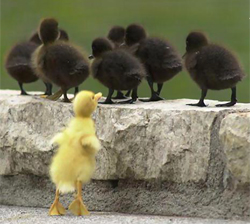
Now I’m in the final sprint–only a few hundred words away from finishing–so I feel OK about sharing with you all.  In fact, I feel more than OK, I want to share because that way you’ll understand why I’ve been a bit more MIA than usual these last few weeks.  Still, part of me is a little superstitious about talking about my WIP so I’ve decided to tell the story in pictures, starring baby animals (because baby animals make any story that much cuter).  Here it is.  The progress report of my WIP (title to be revealed later) told in pictures.

Enjoy! <3 <3 <3

At first, things were going swimmingly.  I finished my thesis,
had a solid outline, and was writing along.  La la la la la…
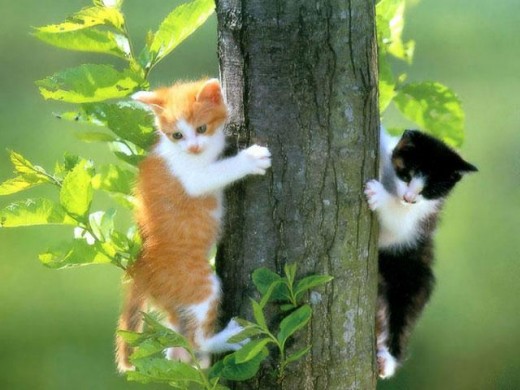
Then, as I was climbing fast toward the climax, I made a fatal mistake:
I looked down.
“Yikes, it’s pretty high up here.”
Lucky for me, I have some great writing buddies
who weren’t afraid to give me a pick-me-up.
I kept writing.
Even so, there were times I just wanted to curl up inside my shell.
Then, I finally made it to the final showdown!
Good thing I’m trained in the art of pen-wielding,
because my villain turned out to be a piece of work.
“Take that, evil character!”
 
Now I’m sprinting to the finish line.
1200 words… 1100… 1000…
And pretty soon I’ll type the two most beautiful words in the English language:
THE END.

How about you?  How’s your writing coming along?  Any NaNoWriMo folks out there?  If so, how’s the experience been treating you?

Write on!

2 Comments »

08 Nov

Famous Last Words

Posted in Process, Writing, Writing Exercises

Everyone’s always talking about first sentences and how important it is that they make an impact and draw the reader into the story.  But what about the last sentences, the words that stick with readers after they put down the book?

As writers, most of us are wired to take a sentence and write forward from it, but how often do we write toward something, toward an ending?  A classic writing exercise is to take a random sentence from a famous novel and write from there, using those words to jump-start our own writing.  Today I’d like to challenge you all to do the opposite.  Below is a list of last sentences, final words from existing books.  The idea here is to write toward these last words so that they fit as the last sentence of your piece.

Here’s a fun exercise! Choose one of the sentences below and write a short piece with the sentence you chose as the final sentence.

  • No one has claimed them yet.
  • “Let me tell you about it.”
  • Everything must go.
  • “Make me pretty.”
  • …and it was still hot.
  • It is not often that someone comes along who is a true friend and a good writer.  [She] was both.

Bonus points to anyone who can guess which books these sentences come from!

3 Comments »

Iggi & Gabi - All rights reserved © 2010-2011

I am a HowJoyful Design by Joy Kelley