24 Jul

DIY MFA: The Ideal Candidate

Posted in DIY MFA, Process, Writing

Last week I started writing about this idea of a DIY MFA.  As I gear up for my super-secret, super-exciting fall surprise, I wanted to talk about who would be the perfect candidate for the DIY MFA.

Qualities Necessary for the DIY MFA

  • Be a Self-Starter:  To follow a plan like this on your own, you need to be the sort of writer who can motivate yourself and keep yourself going.  While it’s great to ruminate and let the muses work their magic, a DIY MFA doesn’t do itself.  You need to be good at pushing yourself because no one will be there to do it for you.
  • Honor Self-Imposed Deadlines:  Nothing imposes a healthy dose of fear in a writer like a deadline.  Problem is, you won’t have class deadlines to motivate you so you need to be good at scaring yourself into getting the work done.  Self-imposed deadlines are very easy to ignore because no one is there to tell you your work is overdue.  You need to come up with ways of giving your self-imposed deadlines enough weight that you get the work done.
  • Reach Out:  Writers need support from other writers.  Conferences and readings are great places to meet other aspiring writers, so don’t be afraid to approach other writers and speak to people.  If you’re shy about meeting people in person, start with reaching out to other writers via blogs, twitter or online writing networks.

Think you’ve got what it takes to do a DIY MFA?  In the fall we’ll be doing DIY MFA extravaganza with weekly themes, a twitter chat and a daily plan to help you set up your very own DIY MFA.  Stay tuned for more about the DIY MFA and in the meantime, feel free to share your thoughts below or tweet your comments using the #diymfa hashtag.


    4 Comments »

    13 Jul

    Getting Back on the Horse

    Posted in Process, Writing

    Dear loyal readers,

    How I’ve missed you and this (virtual) space.  My apologies for the almost-week-long hiatus but I was struck down by a nasty summer flu and spent the week in a cough-medicine-induced stupor.

    Well, that was until Sunday.  After that, the worst of the flu had passed but I got hit by writing paralysis (which often happens if I’m away from writing for too long).

    Which brings me to the subject of this post.  What do you do when you need to get back on the horse?

    I often have a hard time figuring out what to do and tend to wallow a bit too long in my non-writing.  Usually, a deadline will crop up and I’ll be forced to produce something which breaks the cycle, but now that I’m done with the MFA, deadlines are a lot more flexible and self-imposed.  This scares the besneezes out of me because it means I don’t have someone else helping me get back on the horse… I have to get up all on my own.

     So tell me, what do you do when you need to jolt yourself back into a writing routine?  I know, I know… BIC (Butt In Chair) and all that, but do you have any tricks to get yourself past that initial paralysis?

    In the meantime, I’ll leave you with a short anecdote.

    The Alf Incident
    When I was a kid, I used to ride; I went to riding school, even won a couple of ribbons at a show or two.  One day, as I was practicing my jumps with a horse aptly named Alf, I learned the true meaning of the phrase “get back on the horse.”

    See, Alf and I had a slight difference of opinion: I wanted him to go over the jump and he wanted to go around it.  Instead, I ended up going headfirst into the jump (thank goodness for helmets!) and ended up on the ground.  My riding teacher insisted I get back on immediately and ride around the ring a few times, show Alf who was boss.  Apparently Alf was boss because as soon as I got on and tried to canter around the ring I lost control again and ended up getting thrown into the ring fence.

    After a trip to the ER I ended up being perfectly fine, just some scrapes and bruises and a bad headache.  That double fall, though, terrified my parents and thereafter they refused to drive me to  riding school.  Dad joked that I could ride to my lessons, but seeing as I had no horse, that option was out.  Not to mention, that I had a slight communication problem with horses as it was, and I probably would’ve ended up halfway across Connecticut in the opposite direction.

    3 Comments »

    04 Jul

    Are You Good at Taking Critique?

    Posted in Critique, Process, Writing

    Here’s a quizzy for you. Answer the following questions, then count up your “Yes” answers and see your score below.
     

    1)  When your critique group says they don’t like your character, is what they’re secretly saying that they don’t like you?

    2)  When a colleague points out a flaw in your manuscript, do you immediately reply with an explanation why that flaw isn’t really a flaw after all?

    3)  You have 5 people in your writing group and they each have a different opinion about your WIP.  Do you try to rewrite your project so that it fits all 5 suggestions?

    4)  When you send your manuscript to your critique partners, do you preface it by saying that the language is “coded” and that you’re going for something “post-modern”? (Meaning, of course, that if they don’t get it, it’s because they’re too dumb to get it and not because you were too dumb to write it like that in the first place.)

    5)  A corollary to #4, when you send your manuscript out, do you preface it by saying it’s really, really rough and you wrote it in two minutes on your iPhone while standing in line at the movie theater?

    6)  Do you refer to your manuscript as “your baby?”

    7)  Do you find it hard to sit through a critique without your favorite comfort food?

    8)  Have you ever cried after a critique but lied and told everyone it was because your hamster died?

    9)  When your short story gets rejected by an editor, do you take it upon yourself to write back and calmly explain why said editor is utterly and completely wrong?

    10)  You got critiqued by your writing group last week, got lots of suggestions for change and this week you come back with a manuscript that is… exactly the same.  No changes made.  Do you expect a glowing critique this time?

    Count up your “Yes” answers and scroll down to see your score.

    0 = You have a level head and you make the most of your critiques because don’t take anything too personally.  You take notes and you know when to incorporate feedback and when to let it go.  Keep it up and you’ll go far.

    1 = OK, so you’re on the loopy side of normal, but you’re still pretty good about not letting critiques get to you.  Sure, you might need to reward yourself for a tough critique session with some ice cream or even a good cry, but that’s fine.  Just make sure you get home and close the shades before you do.

    2-3 = You are a tricky one.  Let’s face it.  On one hand, you are a bit… how shall I put this… wacko.  The thing that makes it so hard for your critique partners to deal with you is that you seem completely oblivious to this fact.  Wake up!  Stop writing like a lunatic.  And start listening to what your critique partners tell you; they might actually be right.

    4-5 = You are in need of a massive reality check.  Here it is.  Your book is not you.  Your book is not your child.  Your book is not a living being.  Get over it.  Now that we’ve made that clear, stop griping about how much everyone criticizes your work and focus on making it better.

    6+ = Seriously?  You seriously answered “yes” to six or more of the above?  Wow.  I don’t know what else to say, but… Wow.  May I shake your hand?

    Comments Off on Are You Good at Taking Critique?

    02 Jul

    ORACLE: A Writer’s Toolbox

    Posted in Process, Writing, Writing Exercises

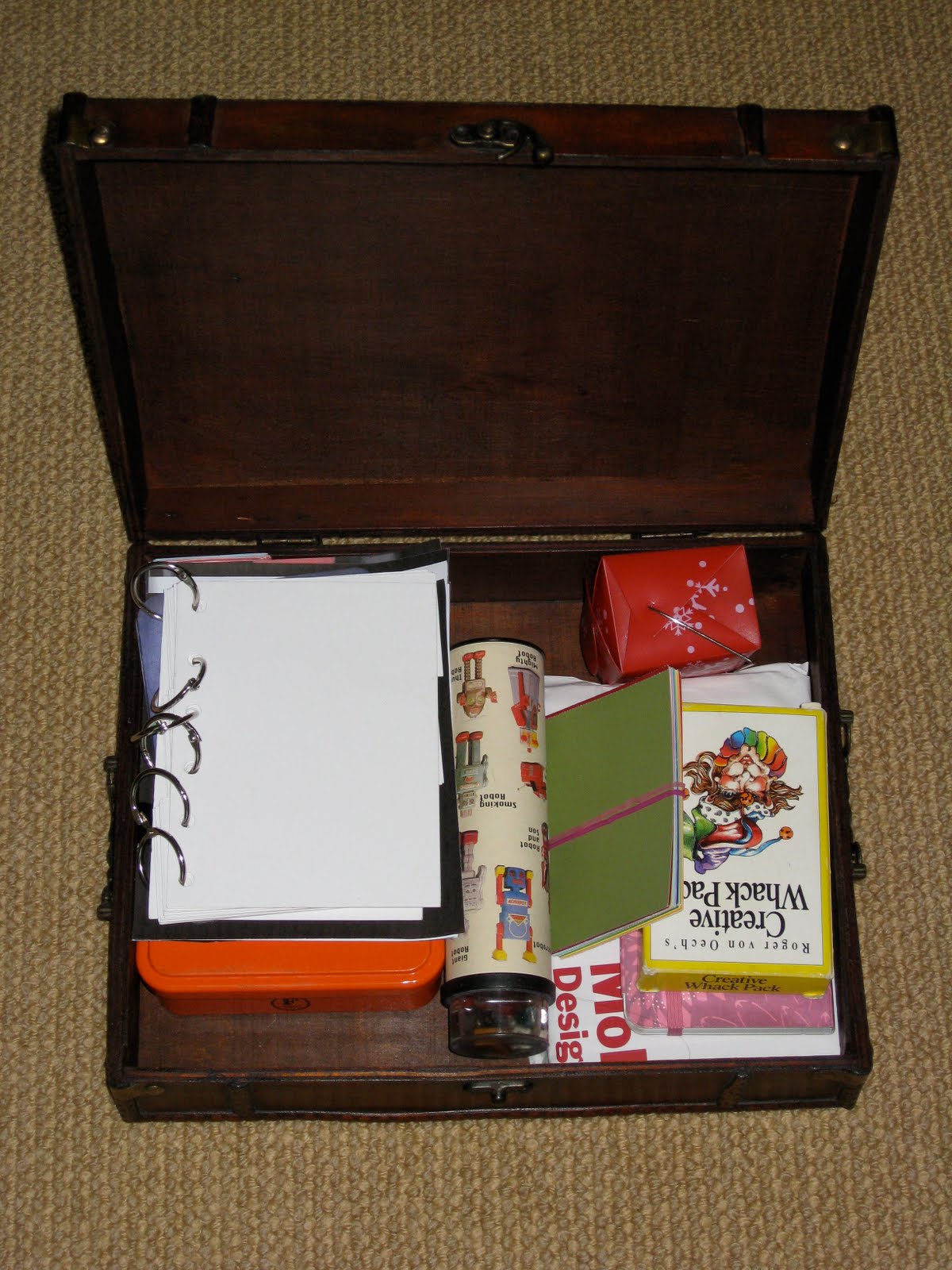
    Lately I’ve had some impromptu teaching gigs and I’ve never been more thankful for my writer’s toolbox (which I lovingly call the ORACLE).  The ORACLE contains tons of writing games and exercises and as you can see from the picture, it’s already overflowing.  Even so, I can never seem to have enough writing exercises.  There’s always room for more.

    The ORACLE includes:

    • Image file
    • Kaleidescope
    • Dice
    • Postcards
    • Writing Block Book (my own design)
    • Mini plastic take-out container with random words in it
    • Fairytale cards
    • Paint chips
    • Creative Whack Pack by Roger Von Oech
    • Brain Book

    The ORACLE Annex (AKA the bookshelf) stores additional items that don’t fit in the ORACLE. 

    These are:

    • The Mysteries of Harris Burdick by Chris Van Allsburg
    • Faces by François and Jean Robert
    • The 3 A.M. Epiphany and The 4 A.M. Breakthrough by Brian Kiteley
    • Now Write! edited by Sherry Ellis

    Searching through my writer’s toolbox and scrounging around for good exercises got me thinking.  I began to wonder: what’s in everybody’s writer’s toolbox?

    2 Comments »

    Iggi & Gabi - All rights reserved © 2010-2011

    I am a HowJoyful Design by Joy Kelley