09 Mar

FAQ About DIY MFA

Posted in DIY MFA

What is DIY MFA?
 DIY MFA stands for Do-It-Yourself MFA.

OK that’s nice, but what-the-hey is an MFA?
The MFA is a master’s degree in the fine arts.  You can go to school for an MFA in any number of fields including: Film, Studio Art and Sculpture, Music, Theater and, of course, Creative Writing.  This is usually a two-year degree (if done full-time), though length can vary between different programs.  Also, some schools offer an MA (Master of Arts) in Creative Writing and some schools even have PhD’s in Creative Writing.

Do you have something against MFA programs?  Is that why you created DIY MFA?
MFAs are great–in fact, I happen to have one.  For some people, the MFA can be a good fit, but for others it just isn’t feasible.  Logistics, time and money are all factors that play into a writer’s decision to do an MFA and for some people it just doesn’t make sense.  But this doesn’t mean these writers are any less serious than their MFA-going counterparts.  That’s where DIY MFA comes in.  I want to share some of the secrets and skills I learned in my own MFA experience and help writers develop their own Do-It-Yourself writing plans.
What is iggi U?
iggi U is the only university–imaginary or otherwise–where you can do a DIY MFA.  It’s called iggi U because iggi happened to be the first creature to graduate from this fine institution.  He’s also the university president, provost, dean and coach for the soccer team.

If I go to iggi U and do the DIY MFA, will I get a degree?

Sadly, no, at least not a real degree.  iggi U would be happy to grant you an imaginary degree but that won’t help you much in terms of building credentials or a resume.  iggi U is a fictitious university and not accredited by any powers-that-be so if your goal is to get an official degree, you’ll need to go to an official school.

The truth is, an official degree would go against all iggi U core beliefs.  The whole point of DIY MFA is that learning can’t be defined by geographical location or a set period of time.  Learning happens throughout life.  You learn something every time you write a new sentence, send out a query or get a rejection.  DIY MFA’s #1 goal is to help you reclaim your writing education and take charge of what you learn, rather than letting it take charge of you.  DIY MFA is about being an active participant in your own writing life.

Any other questions about DIY MFA that you’d like me to answer?

3 Comments »

08 Mar

Coming Soon: DIY MFA 2.O

Posted in DIY MFA

That’s right, DIY MFA is coming back in April for another month-long spree of writing fun!  For those who aren’t familiar with the Do-It-Yourself MFA concept, you can visit iggi U and check out posts from our first extrabloganza last September.

DIY MFA 2.O will be all about getting the creative juices flowing.  Didja notice that it’s the letter O and not a zero?  That’s because the O stands for ORACLE, which will be a huge part of this new version of DIY MFA.

What’s the ORACLE, you ask?  The ORACLE is a place where writers go to commune with the muse.  The acronym stands for: Outrageous, Ridiculous, and Absurdly Creative Literary Exercises.  Remember how in ancient times, people would go visit an oracle to get answers to life’s problems?  This is sort of the same idea except this ORACLE helps you bust your way through writer’s block.  No, the ORACLE won’t write your book for you, but it does put you in touch with awesome ideas and scrumptious stories buried in your brain.

In this new version of DIY MFA, we’ll be focusing on bringing some of those stories-to-be out of hiding.  We’ll build a secret stash of writing ideas so that when you’re under pressure to find new stories, you’ll have somewhere to go where you can find them.

But I’m getting ahead of myself.  First things first.  Over the next few weeks, I’ll be fine-tuning my plan for April and I needed some input from you all.  I want to know what you think worked and didn’t work about DIY MFA in September, and what you want to see more of DIY MFA 2.O.  And, if you didn’t participate in September, I want to hear from you too.  My goal is to make this the best DIY MFA yet,  just for you.

Please share your iggilicious thoughts in the form below.  If you have more detailed comments to add, feel free to leave them in the comments section.  Thank you!

2 Comments »

02 Feb

Where Do Characters Come From?

Posted in Character, Craft, DIY MFA, Writing

Some people collect stamps or seashells.  Some collect bottle caps or baseball cards.  Some even collect parking tickets.  I collect characters.  I squash them between the pages of my notebook, the way you might press flowers (or faeries).  I’ll let you in on some of the secret sources I turn to when I need to boost my stash.

In Real Life:  Basing characters on real people has some major advantages.  For starters, you’ll be able to observe an actual person (or if the real life person is dead, you’ll most likely be able to rely on primary source material).  Not only that, if you’re ever wondering what your character would think or do about something, you can just ask.  That said, there are two drawbacks you’ll need to consider if you decide to base a character on someone from real life:

  1. You could get sued.  You can avoid this problem by doing one of three things.  A) Avoid saying anything that could get you into trouble, which could lead to a very boring story.  B) Change enough of the details so that it’s no longer obvious that you’ve based the character on a specific person.  C) Base the character on someone who can’t sue you… like, say, your cat.
  2. You might get so caught up on being true-to-life that you’ll kill your story.  Remember, fiction is by definition fictional.  It’s not about getting the facts exactly right; it’s about crafting a story that reveals a greater Truth about life, humanity, all that good stuff.  Of course you can base certain elements of a character on a real person but in the end, you may have to discard some details that echo reality in favor of ones that will serve the story.

Situations:  The place where I discover most of my characters are in the situations themselves.  I often start with a vague idea like: “What if when you die, your job becomes to convince other newly-dead people about the benefits of being dead?”  Then I work on developing a character who would be the worst possible candidate to cope with that situation.  I know this sounds counter-intuitive.  After all, we’re usually taught to develop our character first then throw obstacles at him or her.  But if you think about it, this method accomplishes the same thing.  The only difference is that instead of starting with a character and developing obstacles that will throw him or her for a loop, you think of the situation first and then develop a character who’s most likely to freak out in that scenario.

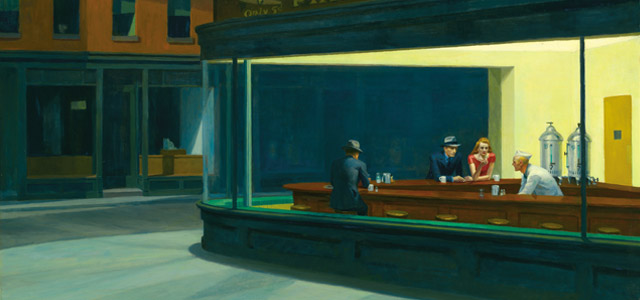
Pictures:  I love looking at a picture and trying to figure out the story behind it.  Some of my favorite artists for this exercise are Edward Hopper, John Singer Sargent, and Edgar Degas.  Photography is also a great resource–especially antique portraits or work that’s photojournalistic in style.  Every time I go to a museum, I’ll get a handful of postcards that I think might spark interesting characters.  These days with the interwebs at our fingertips, we can find inspiration without even leaving the comfort of our office chair.  Here’s one of my favorites:

Quotes:  One of the great things about living in a big city is that people will say the craziest things in public.  Seriously, it boggles my mind what some people will say while riding the subway or talking on their cell phones.  I used to feel bad about eavesdropping but now I figure, if these people are talking that loud, it’s because they want me to hear and use it in my book.  Whenever I hear a good line, I jot it down right away.  Here’s one I recently rediscovered in an old notebook:  “What do you mean she’s pregnant?  I thought she was just getting fat.”  Even though I just wrote down the quote and made no notes about the speaker, I get a clear mental picture of this character right away.

What about you: where do you go to find characters?  I showed you my sources, so now you show me yours, k?  Awesome.

7 Comments »

20 Jan

The Portacle

Posted in Brain Boot Camp, DIY MFA, Inspiration, Writing

As of last weekend, our house has been slowly disappearing into boxes all around us.  We still have another three weeks until we move, but because I’ll be busy with conferences the next few weekends, we’ve had to get a jump start on the packing.  Perhaps the hardest part about the move has been parting with all my writing books/supplies/knick-knacks (even if just for a few weeks).  This is where the Portacle comes in.

Portacle = Portable + ORACLE.

As some of you may recall, the ORACLE (along with my special writing space) is where I keep my miscellaneous writing ideas, prompts and exercises.  But alas, my beautiful workspace and containers of treasure are slowly disappearing into boxes and I’ve had to ask the tough question: which parts of my workspace can I absolutely NOT live without for the next three weeks?

Here’s my list:

For Writing

  • Journal (unlined)
  • Stickers
  • mini Image File (a couple of postcards tucked into the journal)
  • Who/What/When/Where/Why/How question cards
  • Small velvet drawstring baggie containing dice, worry stone and beaded charm

For Reading

  • Kindle
  • Amazon gift card (Christmas gift – to be used only in literary emergencies… like if I run out of things to read between now and February)
  • The Iliad (Fagles translation) for some light reading or to cure insomnia, not sure which

For Teaching

  • The Art of the Short Story (the textbook for the class I’m teaching)
  • Strunk & White (duh)
  • Ordinary Genius by Kim Addonizio
  • Reading Like a Writer by Francine Prose
  • Good Poems by Garrison Keillor
  • Two books on craft (one poetry, one fiction)
  • Graphic Novel version of Pride and Prejudice (because I can’t survive without at least one version of my favorite book)

I can’t tell you how much it has pained me to store away my books.  On Writing (Stephen King).  Writing Down the Bones (Natalie Goldberg).  Bird by Bird (Anne Lamott).  I mean, it’s almost like taking your friends and squashing them into boxes.  It’ll be three whole weeks (or longer) before I see any of their shiny, smiling covers again.

But hubby put his foot down and said I had to pack the books.  Either that, or the movers wouldn’t take them and I was going to have to move the books to the new place all by myself.  (I hate it when he makes sense and sounds reasonable.)

Still.  All these empty bookshelves make me feel so darn lonely.

Guess what I’m unpacking first when we get there!  🙂

3 Comments »

Iggi & Gabi - All rights reserved © 2010-2011

I am a HowJoyful Design by Joy Kelley