21 Mar

ORACLE

Posted in Creativity, DIY MFA, Process, Writing

You’ve heard me mention the ORACLE in the past, but today I thought I would give you a more detailed look at what the ORACLE really is. First things first; the ORACLE stands for:
Outrageous
Ridiculous
Absurdly
Creative
Literary 
Exercises

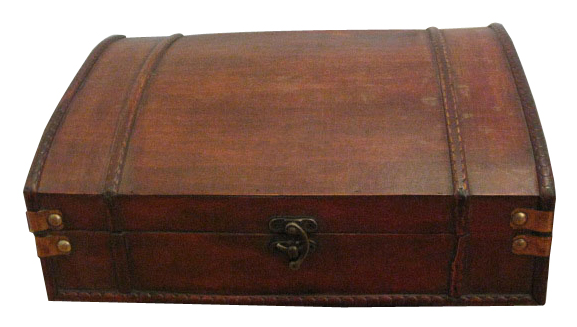
I store my ORACLE in a treasure chest because every time I visit, I like thinking that I’m going to discover a little piece of treasure.  What’s inside this box of tricks?  I’ll show you:
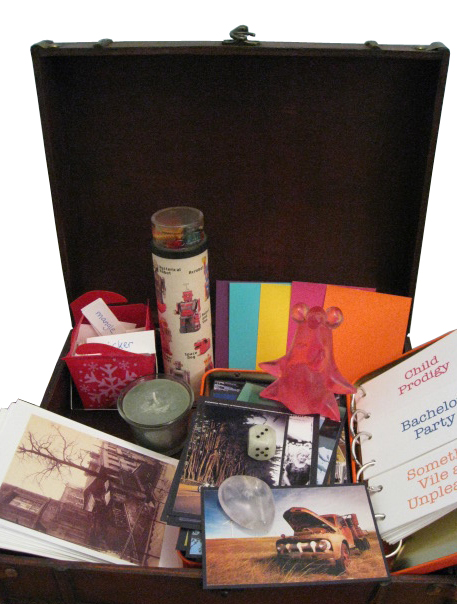
These are just a few things that live in (or near) the ORACLE.  The box is so jam-packed with stuff that some things no longer fit in the ORACLE proper and have been moved to various annex locations.  There are also some additional items not show in the picture, including: mood playlists on my iPod, a deck of cards (for playing solitaire), and of course the Idea Bank.

Why do I keep bringing up this ORACLE idea?

Because the ORACLE will be central to the structure of DIY MFA 2.O.  Just like DIY MFA is about giving you the tools to build a satisfying and productive writing life, the ORACLE is about building a diverse skill set for generating ideas.  Sure, I could give you prompts or exercises from my own ORACLE, but at the end of April, where would that leave you?  Instead, I’d rather give you tools and tricks I’ve developed that will help you come up with your own infinite bank of ideas.  That way, you’ll always have somewhere to turn if your creative well goes temporarily dry.

But before get carried away, we need to talk about some ORACLE basics.  This week, in preparation for DIY MFA 2.O, I’ll be doing a post series on the ORACLE.  Posts will include:

  • 5 Principles for Generating Ideas
  • 4 Results You Can Expect from the ORACLE (and I’ll let you in on which one will be especially important to DIY MFA 2.O)
  • The DIY MFA 2.O Schedule

In the meantime, I want to hear from you.  I showed you what’s in my writing toolbox, now show me yours, ‘k?  What are some things in your writing toolbox that you simply cannot do without?

3 Comments »

20 Mar

DIY MFA: Writing Sprints and a Marathon

Posted in Blog, DIY MFA, Info, Tips

Today I wanted to give you all an update on DIY MFA.  Over the next two weeks , I’ll be doing a few lead-up “DIY MFA Orientation” posts, explaining some background (especially important if you’re new to DIY MFA and didn’t participate in the fall).  A week from this Monday, I’ll be opening sign-ups for DIY MFA 2.O and I’ll be announcing a sooper-seekrit, sooper-exciting giveaway.

But first off, I wanted to talk about two things that I’m really excited about but are new to DIY MFA this time around.  These are: writing sprints and a writing marathon.

Every Saturday during April, I’ll be doing DIY MFA Writing Sprints.

Here’s how it works:  I’ll be blocking out a chunk of time (between one and three hours) each Saturday in April to make a mega-push on my writing.  Sure, this might mean making some sacrifices–like waking up an hour, or two, or three earlier than usual (ugh)–but we writers need to get used to making sacrifices for our work.  These sprints will be good practice.

I’m telling you about these sprints because I’d love for you to join me!

I’ll be making some iggilicious badges that you can post on your blog to show off your awesome weekend accomplishment.  Also, you can use the twitter hash tag #diymfa to share how long or how much you wrote.  If you don’t tweet, you can also share your results in the comments for that day’s DIY MFA post.  Cheer-leading other DIY MFA tweeps is strongly encouraged.  The idea is to create an online community of DIY MFAers writing together and encouraging each other even if they’re in totally different locations across the globe.

On Sunday May 1st, to celebrate the end of DIY MFA, I’ll be doing a Writing MARATHON.  This idea was inspired by Natalie Goldberg’s Writing Down the Bones but is a little bit different.  Rather than committing to a specific time/place, writers can commit either to a full marathon (~6 hours) or a half marathon (~3 hours), then write those hours whenever or wherever during that day.

I myself will camp out somewhere in NYC and write ALL DAY.  I’ll post where I’m writing so that folks in NYC can come by and join even if it’s just for a short sprint.  Also, like with the sprints, people are encouraged to tweet their progress and encourage each other to make it through the marathon.  At the end of the day, we’ll have a post-marathon, post-DIY MFA twitter party!

So my question for you is: are you in?

12 Comments »

18 Mar

YA Cafe: Searching for Short Stories

Posted in Reading, Teen Lit, YA Cafe

Welcome Back to YA Cafe, where book lovers can gather and chat about teen literature.  I’m your barista, along with Ghenet from All About Them Words.

Each Friday we pick from a menu of topics and share our thoughts on our respective blogs.  We’ve also got plans brewing for interviews, events and even some exciting giveaways, so stay tuned!  Join the discussion by responding in the comments, on your own blogs or on twitter using the hash tag #yacafe.

 Today’s Special:  Short Stories for Teens

I love short stories.  I use them for teaching and I also like reading them for fun.  Part of why I like them so much is that you get a whole story–beginning, middle and end–in one small package.  You can read the whole thing in one sitting and don’t have to wait until next time to find out what happens.  For someone like me who reads book endings compulsively, short stories are the perfect solution.

The only problem is, it’s nearly impossible to find short stories written for teens because there are very few venues that publish them.  I have managed to find a few anthologies especially for teen literature.  Here are some of the ones I’ve read recently.

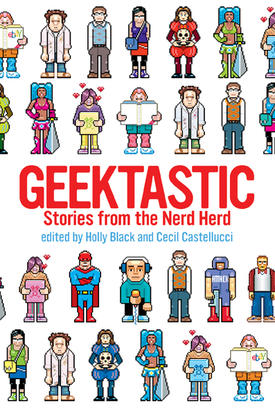
Geektastic (edited by Holly Black and Cecil Castellucci): This is one of my all-time favorites.  In this anthology, YA greats (Libba Bray, Bary Lyga, Sara Zarr, M.T. Anderson and David Levithan, just to name a few) share stories about various areas of geekdom.  From trekkies  to gamers to theater geeks, this anthology is one delicious collection of all things geeky.

Zombies vs. Unicorns (edited by Holly Black and Justine Larbalestier): This book attempts to answer that all-important question: which is cooler, zombies or unicorns?  Personally, I’m on team unicorn because animals that fart rainbows amuse me.  What about you, are you team zombie or team unicorn?

Love is Hell: Part of the same series as “Prom Nights from Hell” and “Vacations from Hell,” this collection has stories by five well-known YA authors that each give a paranormal twist to the typical YA romance.  Not as entertaining as Geektastic or Zombies vs. Unicorns but still fun, in that guilty pleasure sort of way.  I read this book on the beach; it’s the perfect beach read.

But never fear, there are more places where you can find great teen literature and Ghenet will be telling you about one of the coolest ones on her blog.  So zoom over there right now and read all about it!

Want to hear more about the AWESOME that’s happening in teen literature?  Fellow barista, Ghenet gives the details on her blog: All About Them Words.  Check it out, then tell us places where you’ve discovered short stories for teens.

4 Comments »

16 Mar

Idea Bank

Posted in Creativity, DIY MFA, Process, Writing

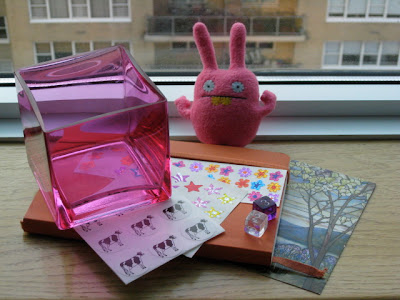
One of the things you’ll need to collect for DIY MFA 2.O is an Idea Bank.  The bank itself can take any number of shapes: a cookie tin, a shoebox, a jar, a small vase.  I’m using this pink cube vase that I found at a thrift shop.

How it works: Write down and any ideas you can’t work on right now and deposit them in the Idea Bank so that they’ll be there for you when you need them later on.  You can keep adding to your stash or taking from it over time.

How is this different from the ORACLE?  The ORACLE is where you keep your creativity tools.  The Idea Bank is where you store the unused fruits of your creativity.

How I use my Idea Bank: I carry slips of paper with me so I can jot down ideas on the go.  When I think of a funny line, prompt or idea for a story, I write it down, fold it up and when I get home I put it in the bank.  Then when I need a creative kick in the pants, I pull an idea out of the bank at random and use that to fuel my writing.

Note that there are no limitations or rules about what you can put in your Idea Bank. In addition to folded pieces of paper, you can also use put in pictures or any other objects that could spark a story or idea.

Hint: If you’re planning to do StoryADay in May, start building up a store of ideas in the bank.

Think about it: if you come up with one good prompt every day between now and April 30, you’ll have more than enough story ideas to get you through May.  Then when you get to the challenge, you can focus on writing and not on thinking up ideas.

Even if you don’t do a month-long challenge like StoryADay, you can still use the Idea Bank to store your ideas until you have time to work on them.  Right now, I’m only alloted two works-in-progress (otherwise I’d have way too many started projects and none that are ever finished).  I use the Idea Bank to store concepts I don’t have time for right now but would like to come back to later.

Have you found an Idea Bank for your DIY MFA 2.O?  What is it?  How do you plan to use it?

6 Comments »

Iggi & Gabi - All rights reserved © 2010-2011

I am a HowJoyful Design by Joy Kelley