06 Feb

Updates! Exciting! Woot!

Posted in Conferences, Info, SCBWI, Updates

Publishers Weekly Blog: Beyond Her Book

My dear friends!  It’s been too long, no?  I am soooo sorry to leave you in the lurch and not post with my usual somewhat-regularity this past week.  Things have been especially nuts on this small slice of the planet where I reside.  Here’s what’s been going on:

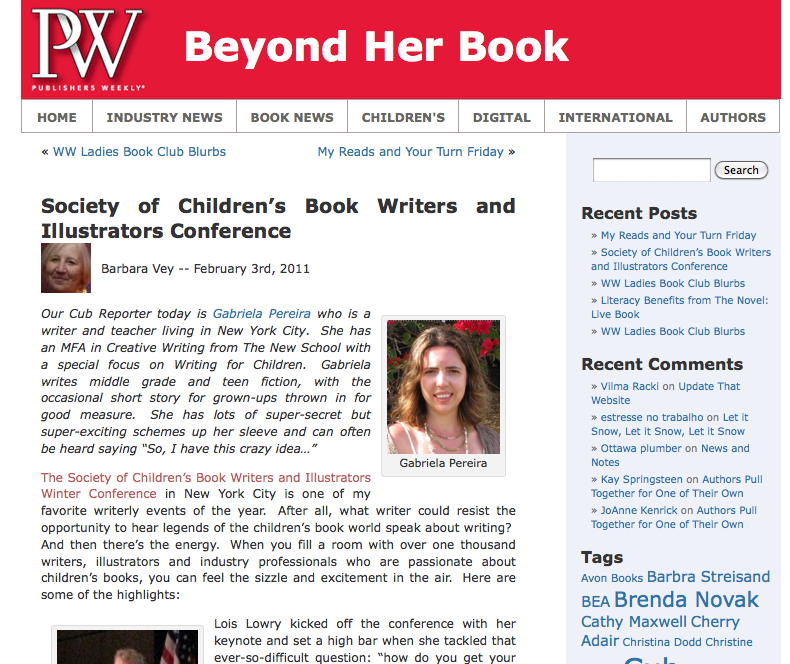
1)  SCBWI Winter Conference in NYC!  OMG, such a fantabulous conference and sooooo much fun.  I have sooooo much to tell you.  Promise I’ll dish all the details real soon, but in the meantime, check out my guest post recap on Barbara Vey’s (of Publishers Weekly) blog: Beyond Her Book

2)  Sooper-seekrit collaborative project shall be unveiled soon!  Actually, Ghenet and I were supposed to unveil it on Friday but an unavoidable incident made it such that I couldn’t access the internet for the latter part of the week so we decided to postpone for a week.  Don’t worry.  It’s coming…

3)  OMG why won’t it stop snowing?  It seems like every week we get more snow dumped on the city.  Or ice.  Or sleet.  And to add insult to injury, it’s almost always on a Tuesday, which is when my writer’s group meets.  While I happen to live and work only a few short blocks from the meeting place–making the snow only a minor inconvenience for me–we have folks coming in from all over the tri-state area and for them it hasn’t been as easy.  Basically, I haven’t gotten to see some of these super-awesome writers in, like, two or three weeks and I seriously need my fix.  Enough with the snow already.  Oh, and did I mention what was in the forecast for Tuesday?

4)  Today’s the Superbowl!  No, I don’t watch football.  No, I don’t have a favorite team.  Actually the only interest I ever have in that sport is watching the Patriots lose and they’re already eliminated so as far as I’m concerned, I don’t much mind who wins.  But after the game, they’re doing a new episode of GLEE, which is the best show EVER.

5)  So what’s in store for iggi&gabi this February?

  •  SCBWI Winter Conference recaps
  • A few last recaps for the Writers Digest Conference
  • Other random iggi-licious things

 Are you excited?  I’m excited.  For those of you who celebrate: have a Happy Superbowl.  For those of you who prefer to watch the post-game GLEE episode… I’ve got your back.

What’s happening in your slice of the planet these days?

3 Comments »

02 Feb

Where Do Characters Come From?

Posted in Character, Craft, DIY MFA, Writing

Some people collect stamps or seashells.  Some collect bottle caps or baseball cards.  Some even collect parking tickets.  I collect characters.  I squash them between the pages of my notebook, the way you might press flowers (or faeries).  I’ll let you in on some of the secret sources I turn to when I need to boost my stash.

In Real Life:  Basing characters on real people has some major advantages.  For starters, you’ll be able to observe an actual person (or if the real life person is dead, you’ll most likely be able to rely on primary source material).  Not only that, if you’re ever wondering what your character would think or do about something, you can just ask.  That said, there are two drawbacks you’ll need to consider if you decide to base a character on someone from real life:

  1. You could get sued.  You can avoid this problem by doing one of three things.  A) Avoid saying anything that could get you into trouble, which could lead to a very boring story.  B) Change enough of the details so that it’s no longer obvious that you’ve based the character on a specific person.  C) Base the character on someone who can’t sue you… like, say, your cat.
  2. You might get so caught up on being true-to-life that you’ll kill your story.  Remember, fiction is by definition fictional.  It’s not about getting the facts exactly right; it’s about crafting a story that reveals a greater Truth about life, humanity, all that good stuff.  Of course you can base certain elements of a character on a real person but in the end, you may have to discard some details that echo reality in favor of ones that will serve the story.

Situations:  The place where I discover most of my characters are in the situations themselves.  I often start with a vague idea like: “What if when you die, your job becomes to convince other newly-dead people about the benefits of being dead?”  Then I work on developing a character who would be the worst possible candidate to cope with that situation.  I know this sounds counter-intuitive.  After all, we’re usually taught to develop our character first then throw obstacles at him or her.  But if you think about it, this method accomplishes the same thing.  The only difference is that instead of starting with a character and developing obstacles that will throw him or her for a loop, you think of the situation first and then develop a character who’s most likely to freak out in that scenario.

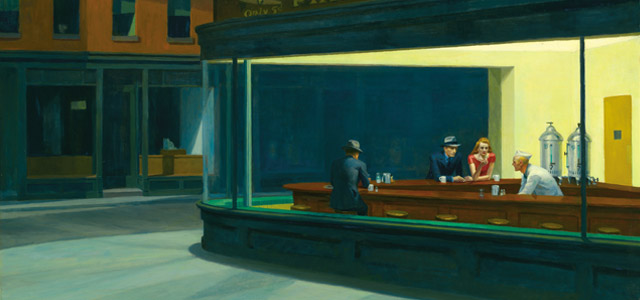
Pictures:  I love looking at a picture and trying to figure out the story behind it.  Some of my favorite artists for this exercise are Edward Hopper, John Singer Sargent, and Edgar Degas.  Photography is also a great resource–especially antique portraits or work that’s photojournalistic in style.  Every time I go to a museum, I’ll get a handful of postcards that I think might spark interesting characters.  These days with the interwebs at our fingertips, we can find inspiration without even leaving the comfort of our office chair.  Here’s one of my favorites:

Quotes:  One of the great things about living in a big city is that people will say the craziest things in public.  Seriously, it boggles my mind what some people will say while riding the subway or talking on their cell phones.  I used to feel bad about eavesdropping but now I figure, if these people are talking that loud, it’s because they want me to hear and use it in my book.  Whenever I hear a good line, I jot it down right away.  Here’s one I recently rediscovered in an old notebook:  “What do you mean she’s pregnant?  I thought she was just getting fat.”  Even though I just wrote down the quote and made no notes about the speaker, I get a clear mental picture of this character right away.

What about you: where do you go to find characters?  I showed you my sources, so now you show me yours, k?  Awesome.

7 Comments »

30 Jan

Writing Conferences: Don’t Be "That Guy"

Posted in Conferences, Tips, Writing

You know exactly what I’m talking about, because we’ve all seen That Guy in action.  You may have even met That Guy, or *gasp* been That Guy.  (If the latter is true, STOP.  Seriously, right now.)

When might you have encountered this rare specimen?

•  Sitting next to you on a cross-country flight, That Guy says: “Oh, you’re a writer?  I thought about writing a bestseller once… you know, like in my spare time.  I’ve got this killer idea.  Maybe you could ghostwrite for me.”

•  During the Q&A session at a conference, That Guy says to an agent: “I’m writing a book on the mating habits of Komodo dragons.  What kind of book deal could you get me?”

• When you’re a publishing intern reading slush and answering phones, That Guy calls saying: “Everyone who’s read my book loves it.  Even my lover/warden/kid/pet goat.  It must be the Best Book Ever and you’d be a fool not to publish/represent it!”

That Guy isn’t always a guy; in fact, about 50% of the time it’s a girl.  That Guy isn’t necessarily a bad writer, either.  That Guy might even get published someday if he/she/it stops being so That-Guy-ish.

So, how do you avoid being That Guy?  Two words: common sense.  Seriously.  It amazes me how many writing and publishing hurdles can be navigated if you use your noggin.  Actually, that’s kind of true in life too.

More importantly, how do you avoid the temptation of punching That Guy in the face?  I still haven’t figured this one out.  But I’ve discovered that watching this video helps.

7 Comments »

30 Jan

Writing: We Are All in this Together

Posted in Community, Conferences, Reading, Writing

Benjamin LeRoy, of Tyrus Books, gave the closing keynote for the Writer’s Digest Conference.  While most of the sessions at this conference focused on craft or the business of writing, this keynote was pure inspiration.  Here are some clips from the speech that struck a chord for me. 
 

“Books allow us to see the world through someone else’s perspective.”

This is one of my favorite things about writing, or reading for that matter.  Books let us “try on” different lives and experience things we would never be able to do otherwise.  As I’ve mentioned before, story-telling is a uniquely human behavior and something that we all have in common, regardless of racial or cultural differences.  Thus, not only do books allow us to adopt different perspectives, but the very act of telling stories unites us. 

“When you take up the pen, you are documenting who we are as people.”

There is something about writing things down that everything seem more real.  As a teenager, whenever something happened at school, I had to write it in my journal, otherwise it was like it didn’t matter.  And if it didn’t matter, then it didn’t feel completely real to me.  In some ways, I still believe that.  As I’ve grown and studied literature, I’ve learned that even written words that are not factually true can ring true on an emotional level.  In many ways, fiction can feel more real that fact. 

“We are all in this together.”

As writers, it’s so easy to get caught up in things like “platform” or “getting published” but the truth is, writers and publishing professionals are on the same team.  As best I can tell, agents and editors are in this game because they love to read great writing and they believe books are important.  Writers get to supply the material.  As LeRoy explained toward the end of his talk, writers should create the best stories they can–stories that engage them–rather than trying to chase trends.

This sounded great in theory and I wanted to believe it–really, I did.   Still, doubt nagged at me so during the Q&A, I asked the following question: 

“Considering how the market is saturated with books about sparkly vampires, and considering how most human beings have the attention span of… say… a small rodent, how do we find readers for our engaging–though perhaps not quite so flashy–books?”

To which, LeRoy smiled and replied: “I don’t know.”

And this was when it all clicked for me.  Throughout the weekend, we’d heard about all the different ways that the publishing industry was changing.  eBooks.  Social media.  Blogs.  POD.  The problem is, it’s not the writing or the publishing that’s actually changing, it’s the reading.  Writers and publishers are just trying to keep up.  Sooner or later, everyone who loves books (writers, agents, editors, publishers, and anybody else) is going to have to figure out how to deal with changes in the reading industry.

This is why it’s important to remember that we’re all in this together.  We may not be able to turn back the clock or un-invent the eReader, but we can find new ways to connect with our readers and with each other.  And that’s a start.

2 Comments »

Iggi & Gabi - All rights reserved © 2010-2011

I am a HowJoyful Design by Joy Kelley