24 Apr

Words, Glorious Words!

Posted in Creativity, DIY MFA, Process, Word Games, Writing Exercises

All writers–whether they write lofty literary fiction or spunky sparkly vampire stories–have one thing in common: an intrinsic love of words.  We can’t get enough of words.  We’re like Oliver, lifting up his bowl and saying: “Please, sir, I’d like some more.”

Today’s post is about glorious words that enrich our love of language.  One tool I’ve developed that helps me rekindle my love of words is the Word Box. 

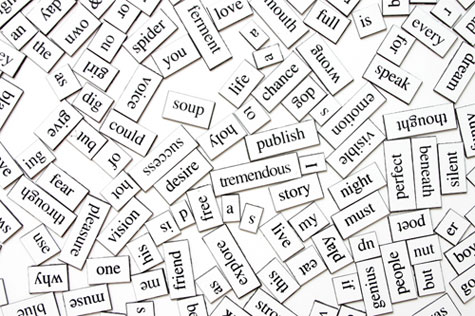
The concept is simple, really; you just cut up a sheet of paper into lots of little slips and write a random word on each slip.  They can be words you love or hate, words that sound funny or that are fun to say aloud.  The point is that the words be random.  Once you’re done, put your word slips in a container (an envelope, bag, small box.  The only requirement is that it should be easy for you to reach in and pull out a few words at random.

How to Use the Word Box: Pull out 3-7 words at random.  Write for 15 minutes and use all the words.  Note: No fair using a random word in a way that doesn’t make sense or feels forced.  All the words have to feel like they belong in the piece.   Tips: (1) Start with with 3 words and work your way up to 7 with practice.  (2) Keep adding new words to your Word Box over time, to keep things fresh.

Homework: Start a Word Box of your own.  With a little help from friends, the task of finding random words can be easy.  Share some of your own word finds in the comments and borrow suggestions from each other!

Here are 20 words from my Word Box to get you started:

galaxy, gamble, fissure, scamper, flutter, flash, troll, manipulate, secret, nefarious, snarl, flinch, croak, glitz, arabesque, pirate, swirl, windswept, totem, no.

A note about DIY MFA Chat today, (5pm ET) I know it’s Easter so I wasn’t sure if any of you were still up for a chat.  Please tweet or comment if you’re still up for chatting and I’ll be there.  If enough people respond saying “yes I’ll be there” then we’ll proceed as always.  Watch the #diymfa thread for a twitter update on the status of the chat.  I’ll a couple of hours before and let you all know if the chat’s still on or if we’re taking the holiday off.  Sound good?

2 Comments »

23 Apr

There Is No Finish Line

Posted in DIY MFA, Process, Writing Sprint

icanhascheezburger.com
We’ve been working our way through DIY MFA and suddenly it has occurred to me that this is our the last week of April (and therefore also the last week of DIY MFA 2.O).  I have to admit, I panicked a little.
 
“OMG, what am I going to do in May?” I thought as I hyperventilated and gasped for air.  And then I remembered: there is no one finish line in writing.  You finish one phase and you start a new one.  Once one goal is met, you move on to the next one.  There are small victories along the way, of course–and we should definitely celebrate those–but ultimately there is no finish.
 
This news might be hard for some of us to hear.  After all, it can be nice to think of one writing project as this big goal and once we finish it, we’re done.  It’s the same way with traditional MFA programs.  Some students focus on the thesis and the program as the end-all-and-be-all, but it doesn’t work that way.  You need to see beyond that finish line to the millions of projects that come after.  It can be overwhelming, to say the least.
Ultimately, I like to look one or two steps ahead.  If you look at all the millions of possibilities, it can make you freeze up.  I prefer to look at just the next step.  Here are a few quotes that have always inspired me:

 “My idea of life is the next page.  The next paragraph.  The next sentence.”
~Charles Bukowski

“Writing is like driving a car at night.  You can only see as far as the headlights, but you can make the whole trip that way.”
~E.L. Doctorow

Homework:  Go to a writing space that’s comforting to you.  Bring a beverage or snack that makes you feel all warm and fuzzy inside.  The point is to coddle your inner writer a little today because you’ll be doing some hard work.
 
Before you start your sprint, take 10-15 minutes and think about the next step.  This is not a time for stressing, but a time for dreaming.  Let yourself imagine the possibilities of what could be next after your current project.  Once you’ve finished brainstorming, bring yourself back to the present, set the dreams aside and do your sprint for today.  (Sprint badges are posted in the photos section of our Facebook page.)
Here in NYC it’s rainy and disgusting so I thought it would be a nice day to write “in.”  I’ll be curling up with my notebook and a pot of hot vanilla-coconut tea and will be brainstorming what’s next after this round of DIY MFA.  I promise to fill you in on the details once I’ve figured it out!

Would anyone like to share what they think their next step is?  I know I’d love to hear it!

5 Comments »

22 Apr

YA Cafe: 5 Essentials For a Story Starter

Posted in Kid Lit, Literature, Reading, Teen Lit, YA Cafe

Welcome Back to YA Cafe, where book lovers can gather and chat about teen literature.  I’m your barista, along with Ghenet from All About Them Words.

Each Friday we pick from a menu of topics and share our thoughts on our respective blogs.  We’ve also got plans brewing for interviews, events and even some exciting giveaways, so stay tuned!  Join the discussion by responding in the comments, on your own blogs or on twitter using the hash tag #yacafe.

Today’s Special: What makes for a successful story starter?

Starting a novel or short story is like making a promise to the reader.  You set up rules and expectations that your readers will rely on as they read your piece.  Specifically, there are five things that you should establish early on in your story to gain the reader’s trust.  Delaying or changing these elements on your reader will create tension and while that might get the reader’s attention, it will also mean you’ll have to work that much harder to gain back the reader’s trust during the rest of the story.

5 Essential Things You Promise to Your Reader:

1) You promise a character.
From the get-go your readers will want to know who they’re supposed to root for.  Sometimes writers will artfully delay the appearance of the main character in order to create anticipation or to reflect the character’s personality, but this is very unusual.  In most cases, the protagonist usually appears in the first chapter, and is often the very first character the reader sees.

A great example of a delayed main character from children’s literature is The Wainscott Weasel by Tor Seidler, in which the protagonist does not appear at all in the first chapter.  (OK, this example isn’t YA, but it’s such a great example, I couldn’t resist.)  Another example, of course, is Pride and Prejudice by Jane Austen, in which Elizabeth’s ultimate love interest–Mr. Darcy–doesn’t appear until well into the story.  In the case of both books, these characters are introverted and shy.  By holding the characters back and making the reader wait for them, the authors show us this facet of their personalities.

2) You promise the voice.
The voice of the narration is central to establishing the mood of the story.  Compare the opening sentences to the following novels and notice the different moods that they convey.

“Everyone thinks it was because of the snow.  And in a way, I suppose that’s true.”
                  ~Gayle Forman, If I Stay
“We went to the moon to have fun, but the moon turned out to totally suck.”
                  ~M.T. Anderson, Feed
“If you really want to hear about it, the first thing you’ll probably want to know is where I was born, and what my lousy childhood was like, and how my parents were occupied and all before they had me, and all that David Copperfield kind of crap, but I don’t feel like going into it, if you want to know the truth.”
                  ~J.D. Salinger, The Catcher in the Rye

Point of view (POV) is also central to the voice and mood.  Notice that in the three above examples, all of the narrators were in the first person, which allows us to hear the character’s voice.  There are other scenarios where the narrator is not the protagonist, but the voice of the protagonist still comes through loud and clear in dialogue.

3) You promise the world.
Promise the world?  As in the whole world?  It might sound huge but it’s not just any world you’re promising, it’s your world.  It’s the world of your book.  It doesn’t matter what genre you’re writing either.  Whether you’re writing contemporary YA set in a regular suburb, or some elaborate fantasy story set in another world, you have to let your reader into that world and it must feel real.

4) You promise a problem.
From minute one, your reader has to know that there’s a problem the character is facing.  Whether that problem is explicit (like the family’s financial state in Pride and Prejudice) or a mystery (like in If I Stay) we know from the first moment that the character is facing some difficulty, some problem.  This promise is essential because whatever this problem is, it will be crucial in establishing the central conflict for your story.

5) You promise an event.
Every book opens with some sort of event that kick-starts the story.  In If I Stay, the event is huge and turns the characters’ lives upside-down (not gonna say what it is, in case any of you reader-friends haven’t read it yet).  In Catcher in the Rye, Holden leaves boarding school and that sets off the chain of events that is the story.  In Feed, we start by going to the moon to have fun and the story unravels from there.  Whether the event simply nudges the story into motion or gives it a sharp shove, there must be an event early on that gets the story started.  Your reader will be waiting for that event, so you will need to deliver.  Try not to delay it for too long.

What do you think?  Any promises I missed and any you’d like to add? 

Want to hear more about YA story starters?  Fellow barista, Ghenet shares her thoughts on her blog: All About Them Words.  Check it out, then tell us what you think!
8 Comments »

21 Apr

Mood Music

Posted in Creativity, DIY MFA, Music, Writing

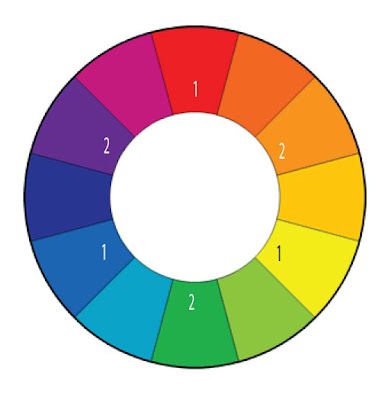
This past week we’ve discussed how to set the mood for writing through reading, collage, color theory and writing rituals.  Today I want to talk about music.

I’ve played the violin on and off since I was four years old, and music has been a central part of my life for even longer than that.  I love music that tells a story.  Here’s a list of the essentials in my music library.

  • The Four Seasons by Vivaldi.
    This classic piece of music sets the tone for each of the four seasons.  For a different take on this piece, check out the recording by Il Giardino Armonico, where the orchestra plays entirely on period instruments but give the piece a contemporary, edgy feel. 
  • The Planets by Holst.
    In this piece, each movement represents one of the planets.  The music captures the personality and sets the mood for each planet.  
  • Such Sweet Thunder by Duke Ellington.
    This jazz suite is based on various plays by William Shakespeare.  Each track represents one play or one set of characters from Shakespeare’s plays.  My favorite is “Up and Down” where the different pairs of instruments are supposed to depict the different couple pairings in A Midsummer Night’s Dream.
  • Symphony No. 6 “Pastoral” by Beethoven
    In my opinion the most beautiful piece of music ever written, Beethoven’s Pastoral Symphony captures the mood of a day in the countryside, complete with waterfalls and streams, a country village and a thunderstorm.
  •  Carnival of the Animals by Saint-Saens
    A great piece–especially for introducing newcomers to classical music–the Carnival of the Animals captures the feeling of being in a carnival.  From the lion to the aquarium to the aviary, each movement of the piece represents one group of animals in the carnival.  A great recording of this is the one conducted and narrated by Bernstein where he explains each of the movements and what to listen for (a great recording for introducing kids to classical music).

If I had to limit my inspirational writing music to just five albums, these would be the ones I’d choose (and it would be a tough choice because I left off some of my absolute favorite pieces).  I chose these five because I feel like they give me the most mileage for my writing.

Homework: Today I’d like you to choose a piece of music and listen–really listen–for at least one track.  Try to hear the story being told in the music.  If you’re not sure of a piece to choose, feel free to borrow one of my selections above.  After listening, jot down a few notes so you remember the story you heard in the music.

Then tell me how it went.  What piece did you choose?  What did you hear in the music?  What story did it tell you?

5 Comments »

Iggi & Gabi - All rights reserved © 2010-2011

I am a HowJoyful Design by Joy Kelley