08 Apr

YA Cafe: 5 Reasons Your YA Character Might Flop

Posted in Character, Reading, Teen Lit, YA Cafe

Welcome Back to YA Cafe, where book lovers can gather and chat about teen literature.  I’m your barista, along with Ghenet from All About Them Words.

Each Friday we pick from a menu of topics and share our thoughts on our respective blogs.  We’ve also got plans brewing for interviews, events and even some exciting giveaways, so stay tuned!  Join the discussion by responding in the comments, on your own blogs or on twitter using the hash tag #yacafe.

Today’s Special: What are your favorite characters in teen literature?

The truth is, I don’t really have a favorite character in teen literature, but I have lots of characters I dislike.  Some I even hate.  Like Holden Caulfield, Alaska from Looking for Alaska, and Harry Potter (especially in book V but, pretty much throughout the latter half of the series).  These characters got me to thinking, what makes me like YA characters or hate them?  And if a character doesn’t work, what’s the reason behind it.

Your YA Character May Flop Because He/She is…

1) Pathologically Self-Centered.  OK, let me start by saying that everybody is at least a little bit egocentric; that’s normal.  What’s not normal is when a character is so pathologically self-centered that he or she doesn’t care about anyone else.  At all.  Not even a little bit.  Take Alaska from Looking for Alaska: she’s so wrapped up in this persona of “traumatized-and-depressed teen” that she couldn’t care less how her actions affect the people who care about her.  Of course, her quirkiness makes her endearing at times so that’s her saving grace.  But if you really want to make your character the worst YA character ever, you need to make sure he has no endearing qualities whatsoever.

2) Pathologically Quirky.  More than the egocentric protagonist, one type of character I detest is the I’m-so-unbelievably-quirky-even-I-can’t-stand-it character.  A mild form of this character is Stargirl, who is quirky in a charming, funny way.  But if you push this quirkiness too far, you end up having a character who’s annoying and just plain weird.  And seriously, if your character’s in high school–don’t you think she has enough problems already? 

3) Pathologically Stupid.  Some characters have plenty of good things going for them, but they are in the habit of making one bad decision after another.  Good ol’ Harry Potter falls into this category (though despite his lack of sense, he still seems to come out on top and that makes him all the more infuriating).  My favorite Harry Potter moment happens in the first book when Neville Longbottom earns the winning points for Gryffindor by standing up to Harry and his buddies for breaking the rules.  If you want your character to annoy the living daylights out of your reader have your protagonist always make bad decisions, then make everything turn out OK for him anyway.  It’ll drive your readers nuts.

4) Pathologically Whiny and Self-Righteous.  With this rule we return to my favorite least-favorite character: Holden Caulfield from The Catcher in the Rye.  He whines from the moment the book starts to the very last scene.  He believes he’s entitled to whatever he wants.  He thinks he’s SO above everyone around him.  *rolls eyes*  As if.  Self-righteous characters who think they’re so much better than everyone else are easy to hate.  Add a dash of whiny entitlement and you’ll have a thoroughly despicable character in the making.

5) Not A Teen.  That’s right.  If you want your book to have the worst YA character of all time, you need to make the protagonist not be a teenager.  Try writing a YA novel about an eleven-year-old.  Or maybe a twenty-something frat boy.  Because teens just love to read about middle schoolers almost as much as they’re dying read about adults (if you could call a twenty-something frat boy an “adult” but that’s beside the point.)  While there are many crossover books that are originally marketed to adults but have teen protagonists, I am hard-pressed to think of one truly-YA (i.e. not crossover) book with a protagonist younger than thirteen or older than eighteen.

What do you think?  What other reasons are there for YA characters that just don’t work?  Tell me because I’m dying to know.  Especially since I want to make sure my main character doesn’t reek of awfulness.  (Yes, I know it’s an ulterior motive, but help a girl out, ‘k?)

Want to read a post that’s actually about favorite YA characters?  Fellow barista, Ghenet shares her favorites on her blog: All About Them Words.  Check it out, then tell us who your favorite characters are!

Also, the winner of last week’s contest (for a signed copy of BITTEN by R.L. Stine) is K.V. Briar!  Congratulations!  *throws confetti*  Thank you to all who entered the contest.  K.V., please email me at iggiNgabi[at]gmail[dot]com with your address so I can mail you your prize.  

11 Comments »

04 Apr

TADA Method of Studying Character

Posted in Character, Creativity, DIY MFA, Reading, Writing

You’ve all probably heard the saying “Show, Don’t Tell” a million times. The trick, of course, is figuring out how.  This is where the TADA method comes in.  I call it the TADA method because when you’re done *TADA!* there’s your character.

TADA deals with the four elements at play in character development that lie within the character herself.  Sure, you can also show us the character by having other characters react to her, or by showing us the contents of her refrigerator, but these do not come from the character herself.  These are all great ways to use the environment as a lens to show us the character, but with TADA we’ll focus on elements that come directly from the character.  These are:  Thought, Action, Dialogue, and Appearance.

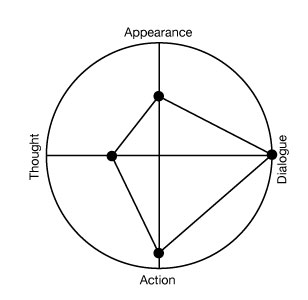
To analyze how the author is using TADA with a character, use a Character Compass.  This is a technique where each axis in the compass represents one letter in TADA.  In two easy steps, you get your analysis.

Step 1: Choose a passage to read.  This can be a passage you’re struggling with in your own writing or someone else’s work.  The important thing is to focus on a short passage (short story, one chapter, one scene).  After all, the way the author shows a character can change from chapter to chapter, or scene to scene.

Step 2: Note down how much of each TADA element appears in the passage.   The closer to the edge of the circle, the more of that element we see for that character.  The edge of the circle is the maximum and the center of the circle means that element was used not at all.

Example: The compass diagram shows a passage with a lot of dialogue and action but little emphasis on thought and appearance.

Note that you don’t need a perfectly balanced compass for the scene or story to work.  The purpose of this technique isn’t to force you to use all four elements of TADA, but to help you analyze how you’re using them.  You might do this exercise and realize that you’re much more dialogue-heavy than you thought.  Or maybe you’ll want to add a little more description of the character’s appearance.  Or maybe you’ll keep it just the way it is because the scene works.

The idea is to help you become more aware of how you’re using these four elements in your writing.  The more aware you become, the more you’ll be able to make certain choices on command, rather than by accident.

It’s also important to practice techniques like this when reading work by other writers.  As we’ve mentioned before, as writers we’re not just concerned with what an author is saying (or why for that matter).  What we really care about is how.  Using the Character Compass, we can become more attuned to how our favorite authors develop their characters.

Homework:  Pick a character in a passage you’re reading (focus on a short story or one chapter of a novel).  Read that passage and make a character compass for the character you picked.  Note: This character does not need to be the main character.

If you’d like a suggested passage to read check out Myla Goldberg’s “Going for the Orange Julius”

Did you learn anything about the passage you read that surprised you when you did the Character Compass?  What did you discover?

5 Comments »

25 Mar

YA Cafe: 5 Ways Romance Can Enhance a Story

Posted in Literature, Reading, Teen Lit, YA Cafe

Welcome Back to YA Cafe, where book lovers can gather and chat about teen literature.  I’m your barista, along with Ghenet from All About Them Words.

Each Friday we pick from a menu of topics and share our thoughts on our respective blogs.  We’ve also got plans brewing for interviews, events and even some exciting giveaways, so stay tuned!  Join the discussion by responding in the comments, on your own blogs or on twitter using the hash tag #yacafe.

Today’s Special:  Why does romance matter in YA?

5 Ways that Romance can Enhance a Story (YA, or not):

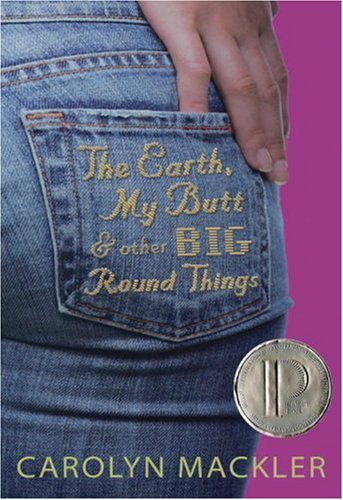
1) It creates conflict.  From Judy Blume to Carolyn Mackler, authors know that adding a romantic interest to a story is a great way to add conflict.  Even if the story itself is not about the romance, having romantic tension can add an element of conflict to the plot.  Take Mackler’s The Earth, My Butt and Other Big Round Things for example.  In this book, the main issue revolves around the protagonist’s self-image and her relationship to her family, but her tension with “the boy” helps add an extra conflict.

2) It offsets violence or sadness.  In books where violence (The Hunger Games) or sadness (If I Stay) are central to the story, having a romantic element brings in a breath of fresh air amidst the pain.  In The Hunger Games moments between Peeta and Katniss give the reader a little break from the constant chaos of the violence.  In If I Stay, the deep sorrow that fills the book is offset by happier flashback moments between the protagonist and her boyfriend.

3) It raises the stakes.  Again, The Hunger Games is a perfect example.  Until Peeta declares his love for Katniss, the main conflict in the story is “Will Katniss win the Hunger Games and survive?”  But the minute we start liking Peeta and we realize that he’s willing to sacrifice himself for Katniss, the stakes get higher.  According to the rules, there can’t be two winners in the games, so for Katniss to survive Peeta will have to die.  Voila!  Higher stakes.

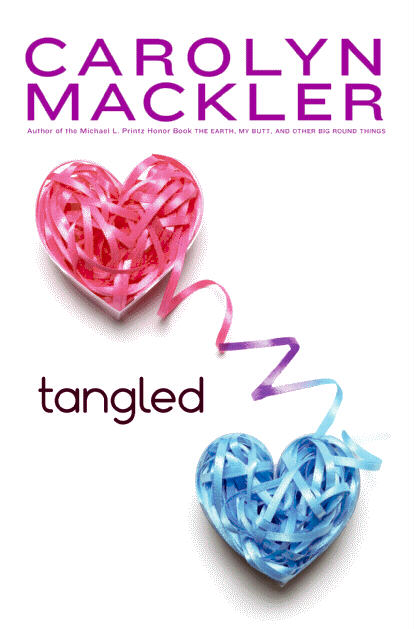
4) It helps make less sympathetic characters sympathetic.  This one was tough to find examples to illustrate, but Dakota in Tangled is a good example.  When we first meet him, he seems cruel and manipulative but as the story develops, we learn details about his romantic life that explain his manipulate behavior.  His budding relationship with a new woman adds depth to his character and makes him more sympathetic.

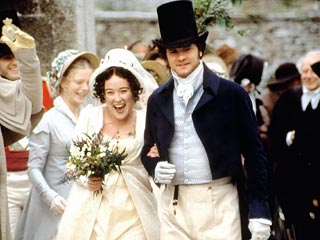
5) Even if we know how it will turn out, we still keep reading.  I call this the Pride and Prejudice effect.  Sure, we know almost immediately that Lizzy and Darcy will end up together, but we keep reading.  The interest isn’t in what will happen, but how.  Unlike any other element or genre in literature, romance is the only one that can be completely predictable and yet will still keep us reading.

Want to read more about romance?  Fellow barista, Ghenet shares her thoughts on her blog: All About Them Words.  Check it out, then tell us why romance in YA matters to you.

6 Comments »

18 Mar

YA Cafe: Searching for Short Stories

Posted in Reading, Teen Lit, YA Cafe

Welcome Back to YA Cafe, where book lovers can gather and chat about teen literature.  I’m your barista, along with Ghenet from All About Them Words.

Each Friday we pick from a menu of topics and share our thoughts on our respective blogs.  We’ve also got plans brewing for interviews, events and even some exciting giveaways, so stay tuned!  Join the discussion by responding in the comments, on your own blogs or on twitter using the hash tag #yacafe.

 Today’s Special:  Short Stories for Teens

I love short stories.  I use them for teaching and I also like reading them for fun.  Part of why I like them so much is that you get a whole story–beginning, middle and end–in one small package.  You can read the whole thing in one sitting and don’t have to wait until next time to find out what happens.  For someone like me who reads book endings compulsively, short stories are the perfect solution.

The only problem is, it’s nearly impossible to find short stories written for teens because there are very few venues that publish them.  I have managed to find a few anthologies especially for teen literature.  Here are some of the ones I’ve read recently.

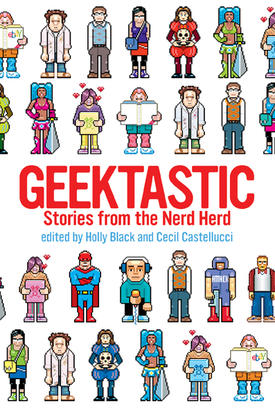
Geektastic (edited by Holly Black and Cecil Castellucci): This is one of my all-time favorites.  In this anthology, YA greats (Libba Bray, Bary Lyga, Sara Zarr, M.T. Anderson and David Levithan, just to name a few) share stories about various areas of geekdom.  From trekkies  to gamers to theater geeks, this anthology is one delicious collection of all things geeky.

Zombies vs. Unicorns (edited by Holly Black and Justine Larbalestier): This book attempts to answer that all-important question: which is cooler, zombies or unicorns?  Personally, I’m on team unicorn because animals that fart rainbows amuse me.  What about you, are you team zombie or team unicorn?

Love is Hell: Part of the same series as “Prom Nights from Hell” and “Vacations from Hell,” this collection has stories by five well-known YA authors that each give a paranormal twist to the typical YA romance.  Not as entertaining as Geektastic or Zombies vs. Unicorns but still fun, in that guilty pleasure sort of way.  I read this book on the beach; it’s the perfect beach read.

But never fear, there are more places where you can find great teen literature and Ghenet will be telling you about one of the coolest ones on her blog.  So zoom over there right now and read all about it!

Want to hear more about the AWESOME that’s happening in teen literature?  Fellow barista, Ghenet gives the details on her blog: All About Them Words.  Check it out, then tell us places where you’ve discovered short stories for teens.

4 Comments »

Iggi & Gabi - All rights reserved © 2010-2011

I am a HowJoyful Design by Joy Kelley