04 Apr

DIY MFA Facebook Fan Page

Posted in DIY MFA

That’s right, DIY MFA has a Facebook page.  Some of you may have noticed the widget in the sidebar.  If you’re on facebook, you should check it out!

But wait!  The point of the page isn’t for it to be all about me.  Sure, I will post links to DIY MFA posts and other news, but I made this page for all of YOU.  I want this to be a forum where fans of DIY MFA can share their thoughts and interact with each other.  After all, blog comments are certainly lovley but they can be a little limiting.  A fan page will allow us to interact with each other that much more!

There are lots of ways you can use this page:
• Share links to your blog when you post about DIY MFA.
• Download iggi badges, sprint badges and other pictures.
• Make longer comments using the Notes function.
• Post pics from your writing sprints/marathon.

And many more!

So check out the fan page, “like” it if you wish, and join the community.

4 Comments »

04 Apr

TADA Method of Studying Character

Posted in Character, Creativity, DIY MFA, Reading, Writing

You’ve all probably heard the saying “Show, Don’t Tell” a million times. The trick, of course, is figuring out how.  This is where the TADA method comes in.  I call it the TADA method because when you’re done *TADA!* there’s your character.

TADA deals with the four elements at play in character development that lie within the character herself.  Sure, you can also show us the character by having other characters react to her, or by showing us the contents of her refrigerator, but these do not come from the character herself.  These are all great ways to use the environment as a lens to show us the character, but with TADA we’ll focus on elements that come directly from the character.  These are:  Thought, Action, Dialogue, and Appearance.
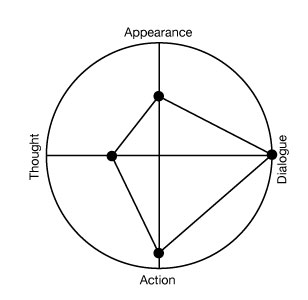
To analyze how the author is using TADA with a character, use a Character Compass.  This is a technique where each axis in the compass represents one letter in TADA.  In two easy steps, you get your analysis.

Step 1: Choose a passage to read.  This can be a passage you’re struggling with in your own writing or someone else’s work.  The important thing is to focus on a short passage (short story, one chapter, one scene).  After all, the way the author shows a character can change from chapter to chapter, or scene to scene.

Step 2: Note down how much of each TADA element appears in the passage.   The closer to the edge of the circle, the more of that element we see for that character.  The edge of the circle is the maximum and the center of the circle means that element was used not at all.

Example: The compass diagram shows a passage with a lot of dialogue and action but little emphasis on thought and appearance.

Note that you don’t need a perfectly balanced compass for the scene or story to work.  The purpose of this technique isn’t to force you to use all four elements of TADA, but to help you analyze how you’re using them.  You might do this exercise and realize that you’re much more dialogue-heavy than you thought.  Or maybe you’ll want to add a little more description of the character’s appearance.  Or maybe you’ll keep it just the way it is because the scene works.

The idea is to help you become more aware of how you’re using these four elements in your writing.  The more aware you become, the more you’ll be able to make certain choices on command, rather than by accident.

It’s also important to practice techniques like this when reading work by other writers.  As we’ve mentioned before, as writers we’re not just concerned with what an author is saying (or why for that matter).  What we really care about is how.  Using the Character Compass, we can become more attuned to how our favorite authors develop their characters.

Homework:  Pick a character in a passage you’re reading (focus on a short story or one chapter of a novel).  Read that passage and make a character compass for the character you picked.  Note: This character does not need to be the main character.

If you’d like a suggested passage to read check out Myla Goldberg’s “Going for the Orange Julius”

Did you learn anything about the passage you read that surprised you when you did the Character Compass?  What did you discover?

5 Comments »

03 Apr

Image File

Posted in Art, Character, Creativity, DIY MFA

I’d like to start DIY MFA by looking at art because that’s one of the writing tools I use most often, especially when I need to find new characters.  It has taken me a while, but I finally have a small collection of postcards that story ideas for me.  These can be pictures almost always depict people, either going about their daily lives or stuck in bizarre situations.  When there aren’t any people in the images, I try to place myself in that scene and imagine what a character would be doing or thinking in that setting.

Image File Litmus Test:  The picture’s content doesn’t matter.  What matters is that I get a sense that the world of the image extends beyond the canvas or photograph.

Warning:  You need to set some limits for yourself.  Rome wasn’t built in a day, and the same is true for image files.  You could waste hours of precious writing time collecting images of characters you’re never going to use.  This is why I prefer postcards.  Every time I visit a museum or a new city, I take five minutes in a gift shop to buy a few postcards.  At first I had only a handful of images, but over time the collection has grown, and without much time, money or effort spent.

Tip:  If you have family or friends who travel, ask them to send you a postcard with a “picture that tells a story.”  This way, your image file can grow even if you’re not collecting the images yourself.  They’ll get sent to you!  Also, it will be interesting to see what images they choose.

Here are a couple of pictures to help you get started.

Eugene Atget, Staircase, Montmartre (1921)
Henri Cartier-Bresson, Juvisy, France (1938)
Karen Halverson,  Furnace Creek, Death Valley, California (1992)
Edward Hopper, Movie (1939)
Archibald John Motley Jr., Nightlife (c.1943)
Pierre Auguste Renoir,  Lunch at the Restaurant Fournaise (1875)
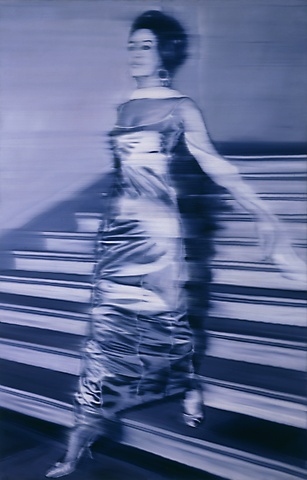
Gerhard Richter, Woman Descending the Staircase (1965)
Sheron Rupp, Trudy in Annie’s Sunflower Maze, Amherst, MA (2000)
August Sander, Children, Westerwald (1920)
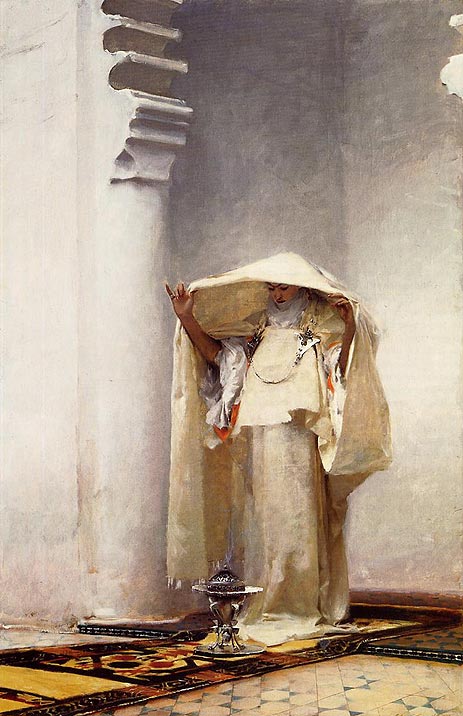
John Singer Sargent, Fumee D’Ambre Gris (1880)

Homework: Find 5 additional images for your image.  These can be postcards, pictures clipped from magazines or even images you captured with a camera or sketchbook.  The important thing is that all five images help us find a character.

Are there any artists or photographers you recommend who are especially good at capturing such images?  Any must-haves I should add to my image file?

10 Comments »

02 Apr

Sprint #1: What You Need to Write Right.

Posted in DIY MFA, Writing Sprint

We all have them little ticks or totems that we can’t write without.  Whether it’s a cinnamon latte or a special notebook or a favorite writing spot, these things shackle us and limit how we do our writing.  Sure, some rituals can be helpful sometimes because they tell our brains “OK, it’s writing time.”  The trick is not to become so attached to these rituals that they become crutches.

You don’t need the right stuff to write.

You don’t need to be in the right mood to write.

You don’t even need the right words to write.

All you need to do is write.  Today is our first Writing Sprint.  There is no assignment or prompt today.  Instead, I want you to write for a chunk of time and focus on breaking away from crutches that shackle your writing.  Don’t overturn your writing habits altogether, just make one small change.

Examples: If you’re used to writing on the computer, use a paper and pen.  If you prefer a noisy coffee shop, go to a library.  If your favorite spot is your own desk, try writing outside.  If you can only write for long chunks of time, force yourself to write in the nooks and crannies of your day.

Tell us on Twitter: How are you shaking up your writing rituals today?

When you’re done, tell us how you did!  Post one of these badges on your blog, tweet your word count or share your writing sprint experience in the comments.

7 Comments »

Iggi & Gabi - All rights reserved © 2010-2011

I am a HowJoyful Design by Joy Kelley