04 Sep

Five Stages of Writer’s Block

Posted in Brain Boot Camp, DIY MFA

When writers aren’t writing, they hurt.  They may not realize that they miss writing, but their behavior speaks volumes.  Often, writers will go through a series of stages of writer’s block before they reach the other side ready to write again.

(1) Denial: 
“I don’t have writer’s block, I’m just really, really busy.  So busy in fact, that I just can’t seem to find time to do all that writing that I know I should do.  But just you watch: as soon as I’m not so busy, I’ll be writing up a storm.”

There’s a reason why denial is the first stage of writer’s block.  If you’re going to get a writing impasse, you first have to identify that it’s there.  The sooner you realize you have writer’s block, the sooner you can get over it and start writing again.

(2) Anger:  “Why can’t I think of any good ideas?  Clearly there is someone at fault here because I’m supposed to be writing the greatest story/novel/poem EVER, but instead I’m here busy with this job/family/life that is taking all my time.  It’s so horribly unfair.”

Anger is often a defense mechanism writers use to avoid writing.  It’s easy to get angry at the world around us for not letting us write, but the truth is, if we want to write, we find the time.  Getting angry is just a way for writers to mask the truth: that they’re not writing.  The cure is simple.  Just start writing.  Heck, write right AT the people or things that make you angry.  Before you know it, the anger will be gone and you’ll be writing.

(3) Bargaining:  “OK, I’ve got it all figured out.  If I don’t write today, but I write doubly much tomorrow, it will even out, right?  And if I don’t write tomorrow, then I’ll just write a triple dose the day after.  Easy-peasy.

Bargaining is a fancy technique but really what it boils down to is denial.  When you start making rationalizations about why you’re not writing or why you can’t write right now, you’re simply denying the fact that you need to write.  The truth is, paralysis breeds more paralysis and the more excuses you make for not writing, the harder it becomes to start writing again.  Don’t let the cycle pick up momentum.  Instead, nip this sucker in the bud.  No rationalizations.  Just sit down and write.

(4)  Depression:  “What’s the point?  Everything I write is lousy so why bother?  I only had one good story/novel/poem in me anyway and I’ve already used it up.  I’ll never write again.”

This is probably the darkest stage of writer’s block because it is at this point that the writer begins to doubt his or her actual ability.  Up until now, the focus of the writer’s inability to write has been external, but now the focus becomes internal.  Freud said depression was anger directed toward the self, and I think there is some truth to that.  The depression phase of writer’s block happens when writers let their frustrations with a certain project become personal.  I was once given a fantastic piece of advice which I’ll share with you now:

“Don’t say ‘I failed,’ say ‘this failed’ and then move on.”

(5)  Acceptance:  “Maybe I have writer’s block and maybe it’s awful and there’s nothing I can do about it.  But that’s OK.  I can still sit down and write through it.”

The reason writer’s block is so painful is because writers really do hurt when they’re not writing (whether they’re cognizant of it or not).  Writers need to write the way most other people need to breathe and when they are not writing, writers grieve.  They mope.  They wallow.

Oftentimes, all it takes is one small step, one tiny push in the right direction to get a writer back on track.  I’ve found that for me, the best cure is acknowledging and then moving on.  Sometimes the trickiest part of writer’s block is actually identifying that we’re hurting.  Once we identify the pain behind the writer’s block, it’s just a matter of finding the cure.  After all, if writer’s block is nothing more than pain from not writing, then the easiest way to get rid of it is to… write!

Today’s Task:  Today’s task is a choose-your-own-adventure.  If you are currently experiencing writer’s block, go to choice A.  If you are not currently having writer’s block, choose B.

(A)  If you chose this task, it’s because you’re currently experiencing writer’s block.  Good for you for being aware and identifying the problem.  Now as best you can, try to identify which stage of writer’s block you’re at right now.  Remember, recognizing the problem is half the battle.  As we mentioned previously, writer’s block is often recycled pain from not writing, so our task for today is gently coax yourself into writing a list.  This list should contain baby steps you can take to break out of the clutches of whatever writer’s block stage you’re in.  Your tactics will be different depending on the stage, but whatever steps you choose, this task should end with you writing (even if it’s just this list).

(B)  You lucky writer, you.  If you chose this task it’s because you don’t have writer’s block right now.  You may want to refrain from sharing that fact with the rest of us, lest we get jealous. 🙂  Seriously, though, while you may not have writer’s block right now, I’d be willing to be that you’ve had it in the past and that you will experience it again someday.  That said, choose the stage where you often find yourself “getting stuck.”  Now make a list in your notebook of things you can do to prevent yourself from falling into that stage’s trap.  This list might contain activities that help jump-start your creativity.  It could also include writing prompts you can use to shake up your ideas.  Depending on what stage you choose, your list could be dramatically different.  (If you like, you could make a list for each of the stages.)  The goal here is to make a preemptive strike against writer’s block and be ready for when it rears it’s ugly head.


9 Comments »

03 Sep

Orientation Week in Review

Posted in DIY MFA, Week in Review

This post marks the end of orientation week and the beginning of DIY MFA!  *does happy dance*
How did this week go for everyone? For me it was lots of fun and a little crazy, which is just how I like it. 
Recap of this Week in DIY MFA:
Saturday: School Supplies! 
People seemed pretty excited for getting school supplies, which didn’t surprise me since I think most writers are.  What did catch me by surprise was how much people seemed to like the sticker idea!  Anyone earn any gold stars or smiley faces this week? (If you’d like a “sticker” for your blog see below for details.)

This one seemed like more of a challenge, but it looked like a lot of you managed to set some good, concrete goals.  The main theme of this post was that while it’s good to have amorphous big goals, you need to break them down into concrete goals to make them more manageable. 

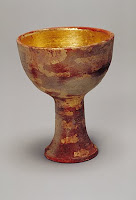
Monday: What’s Your Holy Grail?
It’s fun to dream big and in this post we talked about finding that dream that propels us and motivates us to take all those concrete steps we talked about on Sunday.  iggi’s holy grail is to take over the world and mine… well, aside from taking over the world with iggi, I’d also like to write a picture book.

Tuesday:  Why Writers Need Community
Writers need community to keep things in perspective and to have like-minded companions who can celebrate or commiserate with them.  It sounds like lots of people agree that community is super-important in the writing life.  There was also a suggestion to set up a DIY MFA community (thanks Sonia!) and I’d love to hear what you all think of this idea.  Would you be interested in participating in a DIY MFA community?

Wednesday: Welcome to iggi U!
Check here for details on how to register for iggi U and other information.  This post also covers the four facets of DIY MFA: reading, writing, critique and community and suggests a way to find a balance between them.

Thursday: Stealing Time
Many writers sooner or later will run into a situation where they need to steal time.  Whether it be between familial responsibilities or corners of time tucked around the workday, writers need to learn to write “on the go” or in the nooks and crannies between things.  Even writers who are lucky enough not to need to steal time, should practice it now and again.  Because you never know when life will sneak up on you.

So tell me, how did this week go for you? 

Oooh, also: I’ve decided to make a series of iggi “stickers” that you all can put on your blogs if you like.  To find the iggi stickers go here: iggi Stickers.

9 Comments »

02 Sep

Stealing Time

Posted in DIY MFA, Process

OK, today I know I’m going to get smacked for what I’m going to say, but it needs to be said.

There will be moments when the people and things you care about most will sabotage your writing.  This is a fact, so no point trying to rationalize their actions.  Of course, they don’t try to do this, it just happens.

“Hey Mom, where are my socks?”
“Yo roomie, it’s your turn to take out the trash.”
“Honey, what’s for dinner?”
“Meow, meow, meowmeowmeow.”
Any of these sound familiar?  This is just a small sample of the tactics that our loved ones use to separate us from our time and our writing.

And don’t even get me started on things like gainful employment, grocery shopping, and getting the car fixed.  These alone already make finding time to write a challenge, but then add on all our social and familial obligations and… wham!  Sometimes it seems like everything in our lives are out to get in the way of us doing any writing.

But this post is not meant to be a rant on how life has hijacked my writing time.  On the contrary, this post is about fighting back.  The fact is,  it’s easy for writers to become the victims.  “Poor-writer-me, I never have time to write.  Life always gets in the way.”  Get over it.  I don’t believe in being a victim, I believe in taking action.  If someone tries to steal my writing time, there’s only one thing I can do:

I steal it back.

And it feels great.

What do I mean by stealing time?  Stealing time is when you grab a chunk of time that normally would be used for something else and you steal it for your own purposes.  Most people call this “multi-tasking” but I think “stealing time” sounds more deliciously subversive and sneaky.  I am a chronic time thief myself and I steal time to use for my writing.  For instance, on the trip to Ireland, I carried my notebook with me everywhere and wrote several of these posts while standing in line at the Book of Kells, or over afternoon tea.  Those of you with small children are probably already experts at stealing time, because you have to be if you want to write and have a family.

Over my years of temporal kleptomania, I’ve happily discovered that I’m more productive during a stolen block of time than if I just had a spare chunk of time lolling around waiting for me to grab it.

Why is stealing time so effective?  It gives your writing a sense of urgency.  If you know you only have a short span of time before your responsibilities tackle you back into submission, you’re more likely to be efficient with what time you do have.  For some people, short writing spurts can actually lead to more progress than if they had smushed those short chunks together into a long writing spree.

Today’s Task: Plot a Time Heist.  Steal a chunk of time today and use it for your writing.  Don’t worry if it’s not much (it can be as little as 5 or 10 minutes).  The point isn’t how much time that you steal but that you actually steal the time.  No fair taking a chunk of time you already had free–that isn’t “stealing time,” that’s just “not being lazy.”  So search out a chunk of time that life has taken from you and steal it back.  As with all heists, start small and build to bigger targets with practice.  Pretty soon you’ll be a pro and you’ll be thieving time left and right.

5 Comments »

01 Sep

Welcome to iggi U!

Posted in DIY MFA

Omigoodness, do you know what today is?  Do you, do you?
Of course you do, because it’s the day we’ve all been waiting for…
 DIY MFA at iggi U is finally here! 

For those just joining us, we’ve been enjoying a few days iggi U Orientation, which will continue through Friday.  Don’t worry, classes will be starting on Saturday and go for a full four weeks, through the end of September.

To register officially for classes (and be part of our super-exciting contest), check out our Course Catalog and then fill out the Registration form.

As you put together your DIY MFA, you can find links to past DIY MFA posts and more information on the iggi U page.

———————-

Now that we’ve reviewed those details, let’s get down to business.  Over the last week I’ve been writing a lot about goals so today we’re finally going to get started on planning specific goals for the DIY MFA.  I’m a firm believer in the idea that a full writing life must include the four main strands of the MFA in writing.  The trick is finding a balance between these strands, and this balance can vary from person to person.

Reading: Writers who don’t read are at a serious disadvantage because they’re working in a vacuum.  Reading, both in your genre and outside it, helps put your work in context.  In DIY MFA, Love of Literature represents the reading component.

Writing: This one’s a no-brainer.  If you don’t write, you can’t be a writer.  It’s that simple.  The trick here is not just the quantity of your writing, but the strategy of it.  I’ve seen writers who are so prolific it makes me want to pinch them to see if they’re human, but then when I look closely at their work it reads like variations on a theme.  The idea of a DIY MFA isn’t just to produce, but to challenge yourself and choose projects that will force you to grow as a writer.  I’m also a pragmatist and I believe that it’s important to make the most of my writing time.  To that end, my suggestion: focus on writing smart and strive for projects that make you grow.  Because this is such a big topic, we’ve got two classes that deal with the writing component in DIY MFA: Craftivity, which focuses on craft, and Brain Bootcamp, which places more emphasis on sparking ideas and creativity.

Critique: Giving and receiving critique can be one of the most valuable parts of the writing life.  Of course, there are several caveats with critiques–many of which we’ll cover over the next few weeks–but when handled strategically and constructively, critique can be the difference between a book being so-so and it being great.  Working the Workshop is the DIY MFA class that covers this topic.

Community: Reading and writing are a solitary business and it’s important for writers to connect with other writers.  But community isn’t just about socializing with writerly folk.  It’s also important to be informed about what’s happening in the business so you can make smart decisions and can avoid pitfalls.  One of the best ways to get this information is through publishing talks, conferences or writer associations.  Another wealth of information is the internet, though you need to be more discriminating because not all information on the internet is true or helpful.  In the end, as we talked about yesterday, it’s about finding the right writing network(s) for you.  These can not only help you meet interesting writers, but can give you access to important information about the publishing business.  Creative Community is where we’ll be talking about finding and building our writing communities.

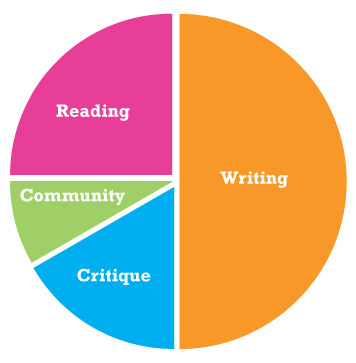
Now I imagine your wondering: “how on earth am I supposed to find time to do all these things?  Some of us have lives, ya know…”  The trick here isn’t just about quantity of time, but quality and balance.  The balance I’ve found that works for me is a ratio where writing gets about half of my writing life time, reading gets one quarter and the rest is divided between community and critique, since the latter two tend to run together.  Like this:

Your Task for Today: Don’t worry, you don’t have to list out a specific schedule (rigid rules often just end up getting broken anyway).  Instead, pull out a sheet of paper and draw a big circle. Now divide the circle like a pie, giving a different slice to each of these four areas: reading, writing, critique and community.

The pie represents the time you plan to dedicate to DIY MFA.  Some people might be able to dedicate several hours a week while others may have to rely on “borrowing” snippets of time between their many responsibilities.  In the end, the focus here is not on quantity, but on balance.  Find a balance that works for you, then divide whatever time you have accordingly.

Hint: Post your diagram somewhere in your workspace, or paste it in your writing notebook.

5 Comments »

Iggi & Gabi - All rights reserved © 2010-2011

I am a HowJoyful Design by Joy Kelley