10 Aug

The Rule of 3: The Flint Heart by Katherine and John Paterson

Posted in Book Reviews, Craft, Kid Lit, Writing
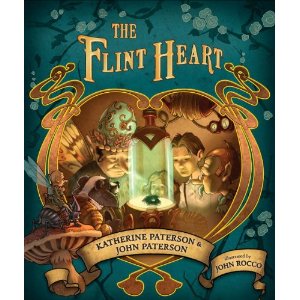
by Katherine and John Paterson, illustrated by John Rocco

“A man, a woman and an emu walk into a bar…”  We’ve all heard that joke before, or at least something along those lines.  They’re always told the same way, with two parts building up to a third that is the punchline.  The Rule of 3.

We hear this pattern in songs too.  “Here an oink, there an oink, everywhere an oink oink.”  But I’m not just talking about children’s songs either; jazz and blues are filled with the Rule of 3.

The best way to illustrate the Rule of 3 in the blues would be to quote the lyrics of the hilarious parody Poppa’s Blues from the musical Starlight Express:


The first line of the blues is always sung a second time.
So by the time you get to the third line, you’ve had time to think of a rhyme.

The Rule of 3.

Finally, we also see this pattern in stories.  The perfect example, of course, is “I’ll huff, and I’ll puff and I’ll blow your house in!”  Not to mention that there were three little pigs, one with a house of straw, one with a house of sticks and one with a house of bricks.  The Rule of 3.

This rule is alive and well in Katherine and John Paterson’s gorgeous book, The Flint Heart, where the evil Flint Heart causes trouble for the woodland community not once, not twice, but a full three times.  This beautifully illustrated novel proves that even today, this age-old technique of grouping things in threes is still quite effective.

So, how does the Rule of 3 work, exactly?  Doesn’t the reader see the punchline coming?  Why is it that even though it’s been around for what seems like forever, the Rule of 3 still holds that element of surprise and satisfaction?  Here’s why:

1) There’s always three.  Not two.  Not four.  Three.  Why three? Because it’s enough to set up a pattern in the reader’s mind, but not so much that the reader gets bored.  If you repeat something only once, it’s not enough for the reader to notice the effect, but if you do it three times, then you’ve got the reader’s attention.

2) There’s a build-up.  Part of the reason why the Rule of 3 is so effective is that when writers use it, they build each piece on the previous one.  The Flint Heart is a perfect example.  The first time the flint heart causes trouble, it is only within the context of one human family.  Next it causes problems within the fairy kingdom.  Finally, the flint heart creates trouble for the entire woodland community, affecting humans, fairies and all the creatures of the forest.  Each iteration is more intense and has higher stakes than the last.

3) Third time’s the variation.  Finally, the Rule of 3 works because the third time is never exactly the same as the first or second.  Think of the three little pigs.  The first two houses get blown to smithereens but the third house of bricks is what does in the Big Bad Wolf.  Think of jokes, where the punchline comes at the end of a chain of three.  Think of the Blues, where the first two lines are often the same, with a variation coming in the third and final line.  Using the first two iterations to establish a pattern, you can then add a variation or twist with the third.  That catches the readers attention and leads to that element of surprise and satisfaction.

Have you used the Rule of 3 in your writing?  How?

4 Comments »

05 Aug

Famous Last Words – Follow Up

Posted in Blogfest, Writing Exercises


Hello all,

I got some comments asking where the different lines came from (and some guesses too!) so I thought I’d do a little follow-up post today to let you all know.  Here goes:


  • No one has claimed them yet.
    From the Mixed Up Files of Mrs. Basil E. Frankweiler by E. Konigsburg
  • “Let me tell you about it.”
    Speak by Laurie Halse Anderson
  • Everything must go.
    Feed by M.T. Anderson
  • “Make me pretty.”
    Uglies by Scott Westerfeld
    (Yay Charmaine and Margo for guessing right!)
  • …and it was still hot.
    Where the Wild Things Are by Maurice Sendak
  • It is not often that someone comes along who i s a true friend and a good writer.  [She] was both.
    Charlotte’s Web by E. B. White
    (Double woot to Margo for getting this one as well!)


My personal favorite is the line from Where the Wild Things Are because it can be interpreted in SO many different ways.  So now, I’d love to know: if you did the exercise, how did it go for you?  Did you come up with something that you weren’t expecting?

Comments Off on Famous Last Words – Follow Up

01 Aug

Imagination Sparks Blogfest – Famous Last Words

Posted in Word Games, Writing, Writing Exercises

Today’s post is part of the Imagination Sparks Blogfest over at Charmaine Clancy’s blog Wagging Tales.  The idea of this blogfest is for everyone to share their favorite writing prompt or exercise, then visit other blogs and try out new and different exercises.  Well, as you already know, here at iggi&gabi we have no shortage of writing prompts and exercises, but today I’ll share with you one of my favorites called Famous Last Words.

I originally introduced this exercise in this post.  This exercise is of my own creation (with the help of the writers who provide the last words, of course) and I love it because it makes you think about your story in a new way.  Most writing prompts start you off at the beginning of a story and you have to write from there.  In this exercise, you get the last line (usually a last line of a famous novel or story), and you have to write to it, ending with that line.  Here are some Famous Last Words to help you spark your story.

Instructions: Choose one of these lines and write a story or scene in which that line comes at the very end.

  • No one has claimed them yet.
  • “Let me tell you about it.”
  • Everything must go.
  • “Make me pretty.”
  • …and it was still hot.
  • It is not often that someone comes along who is a true friend and a good writer.  [She] was both.

Extra credit: Can you guess which novels I took these lines from?  Bonus points to anyone who can!  Here’s a hint: they’re all from books I love to read (so either children’s or teen literature).

For more awesome exercises, visit Charmaine’s blog and check out some of the other people doing the blogfest.  And most importantly, have fun!

9 Comments »

29 Jul

YA Cafe Book Club: Tangled by Carolyn Mackler

Posted in Reading, Teen Lit, YA Cafe

Welcome Back to YA Cafe, where book lovers can gather and chat about teen literature. I’m your barista, along with Ghenet from All About Them Words.

Each Friday we pick from a menu of topics and share our thoughts on our respective blogs. We’ve also got plans brewing for interviews, events and even some exciting giveaways, so stay tuned! Join the discussion by responding in the comments, on your own blogs or on twitter using the hash tag #yacafe.


You know when you’re reading a book, and you’re about three chapters in, and all you can think is “where is the author going with this?”

Then you get this sneaking suspicion that this author knows what she’s doing–maybe because you’ve read previous books, or maybe because you want to give her the benefit of the doubt. It doesn’t really matter why you keep reading. All that matters is that you’re willing to trust the author and go along for the ride.

And you know that feeling you get when you reach the final chapters of that same book and the author managed to pull off what you thought was impossible and the ending totally delivers?

That was exactly how I felt when I read Carolyn Mackler’s Tangled. Having read all of her previous books I was excited… but also slightly terrified… to read this book. This is a new approach for her, juggling four different point of view characters (two of them are boys!), and telling a story in short spurts rather than one long narrative that spans the entire novel.

I was worried about a lot of things. Like what if it wasn’t really one story? What if it turned out to be four loosely-connected novellas? Don’t get me wrong, I have no problem with novellas, but if I’m sitting down to read a novel, I have certain expectations. Like, I need an overarching narrative, however loose that narrative may be. And I want to see the characters grow and change throughout the book. How on earth was Mackler going to pull this off if she was jumping from one character to another and if each character’s story takes place in a different time/place than the other stories?

When I read Jena’s story, my apprehensions grew exponentially. Jena’s character is an archetype we’ve seen in Mackler’s work before (in particular, the protagonists in her first 3 books all have certain similarities to Jena). But the thing that always made Mackler’s depiction of this archetype satisfying in her other books is that, in the end, the smart-but-not-very-popular girl who’s insecure about her looks always seems to learn to accept herself as she is. It’s a message of empowerment that I always looked forward to in Mackler’s work. Needless to say, by the end of Jena’s section of Tangled I was devastated. It felt like the message was: life sucks, and it keeps on sucking.

With each subsequent section of the book, I grew more relieved. At first, I was worried that we would be getting a “grass is always greener” moral and that the point of the book was just to show that even so-called popular kids have problems. But I should have known that Mackler wouldn’t settle for an answer that easy. In the end, this book isn’t just about seeing the other side of a situation or understanding how the other person feels. Really, this book is about reaching out to that other person.

The structure of the book perplexed me at first. We see a lot of “before” and “after” moments with these characters, but we rarely see the actual change. Most of the time, the moment of transformation happens “offstage” between sections and we only get hints of it later on in the novel. Then it occurred to me that this book really isn’t about change. The fact that these characters will change is a given, but what truly matters is how these characters help to transform one another.

It takes a lot of guts to write a book like this, where you have to hope that your readers will trust you to know what you’re doing.  Mackler had gotten really good at writing the smart-but-not-very-popular heroine and suddenly she comes up with Tangled which turns all her previous books on their heads.  Not many authors are willing to break away from their tried-and-true styles to try something new, but Mackler definitely did that here.  And suffice to say, she did so beautifully.

Tangled is an interesting departure for Mackler. While her previous books have mostly focused on one protagonist’s path to self-discovery and acceptence, this book emphasizes the importance of connection with others. In the end, I had nothing to worry about, but worrying actually made me enjoy the book all the more.  I became invested in wanting to see how Mackler was going to pull this off, how she was going to redeem some seemingly un-redeemable  characters.  But she did.

It’s like that car insurance commercial: I should have known all along that I was “in good hands.”

Want to read more about Tangled: check out Ghenet’s response at All About Them Words.  Then share your thoughts with us in the comments or on your own blog.  (Don’t forget to leave a link in the comments so we can check it out!)

4 Comments »

Iggi & Gabi - All rights reserved © 2010-2011

I am a HowJoyful Design by Joy Kelley