14 Jul

Fashioning Fiction: Guest Post by Olivia Bennett

Posted in Book Reviews, Craft, Kid Lit, Reading
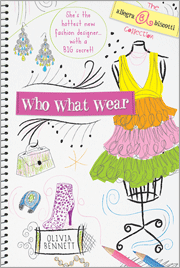
Today we have a fabulous guest post from Olivia Bennett, author of Who What Wear: The Allegra Biscotti Collection, just released in June 2011.  This charming book continues the adventures in fashion of Emma Rose, who is also secretly the hip new fashion designer Allegra Biscotti.  I had the pleasure of reading this book, not realizing it was actually the second one of the series.  And unlike many sequels that often lean heavily on the first book, this one holds its own as elegantly as one of Allegra’s designs.  After finishing Who What Wear (and of course, going back to read the first as well!) I knew I had to get Olivia here at the blog to share a few secrets of how to fashion a story for young readers.  For more information on Olivia or The Allegra Biscotti Collection, please visit the Who What Wear webpage.  Now without further ado, here’s Olivia Bennett with FASHIONING FICTION.

—————————————————-

“She wore a black cotton cardigan–on which she had replaced the plain plastic buttons with marching band uniform buttons–over a white tank top and black, gray, and white camouflage pants from the Army-Navy store and her favorite silver sneakers.”

With the above description, I introduced Emma Rose to the reader in the first book of THE ALLEGRA BISCOTTI COLLECTION. Because ALLEGRA is fiction with a fashionable twist, I felt it was very important to not only show the fashion but to use the fashion as way to describe the characters via what they chose to wear or not to wear. Emma—who later takes on the double life of fashion designer Allegra Biscotti—is creative above all else. While couture and designers matter very much to her, she thrives on the creative (and so the detail about the DIY buttons), does not aim to stand apart from her middle school peers (thus the tank and under-the-radar colored pants), yet is an individual who embraces a special sense of fun and whimsy (finally, the silver sneakers).

Description is what makes a story real, especially for middle-grade readers. It allows the reader to feel as if she is really in Allegra’s design studio or standing by the racks of gasp-worthy clothes lining Madison’s sleek offices. The question often becomes—how much detail to bring to your descriptions.  Allegra is a fashion series so, knowing my audience, all clothes were described in painstaking detail. However, my readers also have a strong desire to create and too much detail would take this almost- interactive process away from them. The key was to give them just enough and then let their imagination do the rest.  Throughout the first two book in the series, I made sure the juicy colors, the weight of the fabric, and the general shape of the garments were vividly described, but allowed by reader to add the little details—buttons, zippers, and all the trimmings.

—————————————————-

Thank you so much Olivia for joining us here at iggi&gabi and sharing your words of wisdom.  Now my questions to all you readers out there: What are your thoughts on giving too much detail vs. not enough?  How do YOU find that balance?  Hint: For an example of how to put this balance into action, check out Who What Wear and The Allegra Biscotti Collection.  Write on!

One comment »

13 Jul

Shaking Things Up

Posted in Blog, DIY MFA, Goals

Some of you may have noticed that things have been pretty quiet here at iggi&gabi.  Don’t worry, the radio silence doesn’t mean I’m gone completely!  Actually, it’s because of some sooper-seekrit but sooper-exciting things that I’m working on that I haven’t had as much time to post as I would like.  I can’t give all the details right now (in part because I don’t know all of them yet) but I can give you a taste of what’s to come.

Author Interviews and Guest Posts:  I’m working with some publicists to start getting interviews and guest posts from published authors.  I think it would be so helpful for aspiring authors (myself included!) to see how published authors do what they do and be able to pick their brains a bit.  I’m really excited about this and as soon as I know more details, you all will be the first to know.  Are there any specific topics you want to hear authors talk about?  Let me know and I’ll try to make it happen!

WIP Revisions: That’s right, after letting my manuscript “breathe” for a few months, I have jumped into revisions.  I have set a steep goal for myself (a chapter a day) and it’s consuming mountains of time.  I’m slightly terrified because no matter how much I shape or polish, it still doesn’t feel done.  Every time I get to the end, I turn around and go straight back to the beginning and start rewriting.  Again.  Is there such a thing as over-revising?  Please help!  Do you have words of wisdom to share about revision?  Any advice on how to tackle this monster?  Most importantly, how do you know when it’s done?

DIY MFA: This is the most exciting of all!  I’ve decided that because DIY MFA 1&2 were so successful, I’m going to expand this project beyond this blog.  I’m working on restructuring and reorganizing the program and giving DIY MFA a home of its very own.  Rather than having DIY MFA happen in short spurts once or twice a year, I want to create a community where writers can engage with DIY MFA year-round.  What kind of features do you want to see in DIY MFA?  Articles?  Videos?  More downloads like the workbook?  Let me know how DIY MFA can best help you!

6 Comments »

08 Jul

YA Cafe: Update

Posted in Reading, Teen Lit, YA Cafe

Welcome Back to YA Cafe, where book lovers can gather and chat about teen literature. I’m your barista, along with Ghenet from All About Them Words.

Each Friday we pick from a menu of topics and share our thoughts on our respective blogs. We’ve also got plans brewing for interviews, events and even some exciting giveaways, so stay tuned! Join the discussion by responding in the comments, on your own blogs or on twitter using the hash tag #yacafe.

Dear Fellow Java-lovers,

YA Cafe will be taking a mini-break for the summer so that we can soak up some sunshine!  That’s right, it’s way too gorgeous out for us to stay indoors all day staring into our computer screens so we want you guys to go out and enjoy the summer.  (Of course, as I write this, it looks like it’s about to thunderstorm outside, but you know what I mean.)

Don’t worry: we will still post for our book club days.

On July 29th, we’ll be discussing TANGLED by Carolyn Mackler and on August 26 we’ll talk about SWEETHEARTS by Sara Zarr!

Just because we’re taking a break for the summer doesn’t mean Ghenet and I aren’t going to be thinking about and working on YA Cafe.  We’ve got some plans brewing and we’ll be back in the fall with more fun stuff like interviews!  Stay tuned.

We also wanted to open up the discussion to all of you reader friends.  We’re dying to know because we want to make YA Cafe super-awesome just for you!  Are there any topics you’d like to see us discuss in YA Cafe?  Any posts that were your favorites?  Please share!

Last, but certainly not least, I just wanted to send out a HUGE thank you to all you readers for your continued support of this project.  As Ghenet said on her post, when we first started YA Cafe, we thought it would only last through February and maybe March.  Now we’ve been going for several months and it’s only because of you guys and all your support, so THANK YOU!

Keep being awesome!

2 Comments »

07 Jul

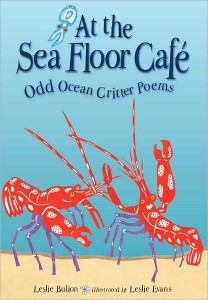
At the Sea Floor Cafe – By Leslie Bulion

Posted in Book Reviews, Education, Poetry, Teaching

I first learned about At the Sea Floor Cafe: Odd Ocean Critter Poems by Leslie Bulion (Illustrated by Leslie Evans) at Book Expo America this past spring.  A book of poems about ocean creatures?  My inner poetry-science geek was instantly intrigued.

While the book is short (I read it in one sitting), you could spend an entire school semester with it and not run out of things to discuss.  In fact, what I liked about this book is that each poem opened up an entire world to the reader, not just with the science but with the poetry structure itself.  Each poem in the book represents a different form ranging from rhyming couplets to free verse, to a pantoum (my personal favorite).  With each poem comes opportunity for a unique lesson plan relating either to the poetry or the science, or both.

My one slight concern with the book is I wonder if it’s trying to do too much.  Reading it in one sitting, the poems began to run together and I felt I wasn’t able to fully appreciate all the detail that went into each poem, both in its structure and in the science behind the verse.  The concept for this book is so smart and unique, I would hate for readers to miss the nuances of each poem by glossing through this book too quickly.

My recommendation for parents and teachers: Ask readers to select one poem and spend time with it, rather than having them read through the book in one go.  The book is short, so the temptation to breeze through it is definitely there, but young readers will get more mileage out of this book if they read through it slowly, one poem at a time.  For each poem, I would encourage readers to do one or more response activities to help emphasize what they learn in the poem.

Ideas:

  • Draw pictures of the ocean critter in the poem.
  • Cut out pictures or search for pictures on the web and make a poster about the ocean critter (what it eats, what its habitat is like, funny behaviors, etc.)
  • Go to the library (or the computer) and look up three cool facts about the ocean critter in the poem.  One rule: These have to be facts not found in the poem.
  • Read the poetry notes about the poem and try to write your own poem in that form.


I thoroughly enjoyed this book.  It has lots of cool facts about ocean creatures, and the poetry notes at the end really show that the author knows her stuff.  Because this book is so full of opportunity for teaching, I would love to see a parents’ guide available to give parents ideas for activities that could go along with this book.  Good teachers will see millions of opportunities with this book and will get a lot of mileage out of it in their classrooms, but for kids reading it at home I think a guide with companion activities would be wonderful.

Overall, it’s a funny and quirky book.  When I teach another poetry workshop for kids, this one is definitely going in my repertoire.

3 Comments »

Iggi & Gabi - All rights reserved © 2010-2011

I am a HowJoyful Design by Joy Kelley